TL;DR: Revenue operations (RevOps) is the business function that unifies sales, marketing, and customer success around shared data, processes, and technology to drive predictable, full-funnel revenue growth. Companies that align their revenue teams under a RevOps model report 36% higher revenue and up to 28% more profitability compared to those that operate in silos. This guide covers the definition, four pillars, key KPIs, tech stack, and exactly when to make your first RevOps hire.
What Is Revenue Operations?
Revenue operations (RevOps) is the business function that unifies sales, marketing, and customer success around shared data, processes, and technology to drive predictable, full-funnel revenue growth. It is the connective tissue across every go-to-market team, responsible for the systems, data hygiene, and workflows that turn GTM strategy into actual pipeline.
Gartner defines revenue operations as "an end-to-end model that unifies customer engagement across functions and integrates people, processes and technology across the business, with the goal to fuel data-led decisions and automate workflows to optimize and increase revenue production." Forrester frames it as "a highly configured, iterative commercial execution strategy designed to maximize customer value and company performance."
The simplest version: RevOps makes sure your entire revenue engine runs on the same data, follows the same processes, and moves toward the same number. When it works, every handoff from marketing to sales to customer success is clean, every forecast is trustworthy, and every rep knows exactly which accounts to prioritize today.
Why Is RevOps Growing So Fast?
RevOps has grown from a niche concept to a core GTM function because the cost of misalignment became impossible to ignore. Gartner predicted that by 2026, 75% of the highest-growth companies in the world would deploy a RevOps model. That prediction is tracking accurately: 79% of organizations entering 2025 already had a formal RevOps function, up from less than 30% a few years prior.
The business case is straightforward. Companies that align people, processes, and technology across their revenue teams achieve 36% more revenue and up to 28% more profitability, according to Forrester research. Companies that align go-to-market teams see 71% higher stock performance and grow three times faster than those that do not, according to SiriusDecisions (now part of Forrester).
The adoption acceleration also reflects a structural reality: the average revenue team manages 12 to 18 separate tools. Without someone owning the integration layer between those tools, data fragments, handoffs break down, and reps lose trust in their CRM. RevOps is the function that prevents that fragmentation from quietly killing pipeline.
What Are the Four Pillars of RevOps?
The four pillars of revenue operations are data, process, technology, and enablement. Together they form the operating system that makes a revenue engine predictable and scalable.
1. Data
RevOps owns the data layer across all three go-to-market functions. This means defining a single source of truth in the CRM, setting data governance standards (field definitions, entry requirements, deduplication rules), and building the reporting infrastructure that leadership trusts for forecasting. Poor data is the most cited barrier to RevOps effectiveness: 38% of RevOps leaders say data accuracy is their top operational challenge.
2. Process
RevOps standardizes the workflows that govern how revenue is generated: lead routing rules, handoff criteria between marketing and sales, opportunity stage definitions, renewal triggers, and expansion playbooks. Process standardization is what makes a team of 5 reps operate with the consistency of a team of 50. Without it, each rep invents their own system, and the data becomes meaningless.
3. Technology
RevOps manages the GTM tech stack: selecting, integrating, and auditing the tools across CRM, sales engagement, intent data, attribution, and forecasting. Modern RevOps leaders are platform owners, not spreadsheet-wranglers. Their job is to ensure every system talks to every other system, that data flows cleanly between tools, and that the stack gets leaner as the company scales rather than more fragmented.
4. Enablement
RevOps supports the frontline teams who execute the revenue strategy: ensuring reps know how to use the tools, understand the process, and have the content and playbooks they need to succeed. Enablement in RevOps is operationally grounded. It focuses on building repeatable motions (not one-off training sessions) that translate GTM strategy into daily rep behavior.
How Is RevOps Different From Sales Ops, Marketing Ops, and CS Ops?
The key difference is scope. Sales Ops, Marketing Ops, and CS Ops each serve a single function. RevOps sits above all three and is accountable to the full revenue number, not any individual team's metrics.
Sales Ops keeps the sales engine running. RevOps designs the engine itself. The practical difference shows up in territory design: Sales Ops assigns territories based on rep capacity. RevOps designs territories based on ICP density, account signal activity, and competitive coverage, then hands that logic off to sales to execute.
Many companies start with a Sales Ops function and graduate to RevOps as their go-to-market complexity increases. The transition typically happens when the marketing and sales handoff breaks down, when CS is operating with different data than sales, or when leadership loses confidence in the forecast.
What Does a RevOps Leader Do? A Day in the Life
At a growth-stage B2B company, a RevOps leader splits their time between systems work (building and maintaining the operational infrastructure), strategic work (translating business goals into GTM processes), and cross-functional alignment (ensuring sales, marketing, and CS are operating from the same playbook).
A typical week looks like this. Monday starts with a pipeline review and CRM data audit: are stage definitions being used consistently? Are opportunities missing close dates? Are new leads being routed correctly? Tuesday might involve a territory planning session with sales leadership to rebalance accounts based on recent signal data. Wednesday is a cross-functional sync with marketing to review MQL-to-SQL conversion rates and adjust lead scoring thresholds.
Thursday is often systems work: testing a new routing automation, deploying a field validation rule to improve data quality, or configuring a new integration between the intent data layer and the CRM. Friday is documentation and reporting: updating the RevOps knowledge base and building the weekly pipeline velocity report that goes to the executive team.
The best RevOps leaders are strategic and technical at once. As one practitioner put it: "RevOps is all about structure, clarity, and saying no to ideas that derail revenue goals." The job is to turn GTM requests into scalable system solutions without creating unnecessary workflows. Saying no to the shiny new process is as important as building the right one.
How Does RevOps Support the Sales Team?
RevOps supports sales by owning every system and process that helps reps sell more predictably, with less wasted motion. The four areas where RevOps has the highest impact on sales performance are forecasting, territory design, compensation, and pipeline hygiene.
Forecasting
RevOps builds and maintains the forecasting methodology that gives sales leadership accurate revenue visibility. This means defining stage-probability mappings, building commit and best-case categories, and auditing forecast accuracy over time. Good RevOps turns forecasting from a political exercise into a data-driven process the whole company trusts.
Territory and Account Assignment
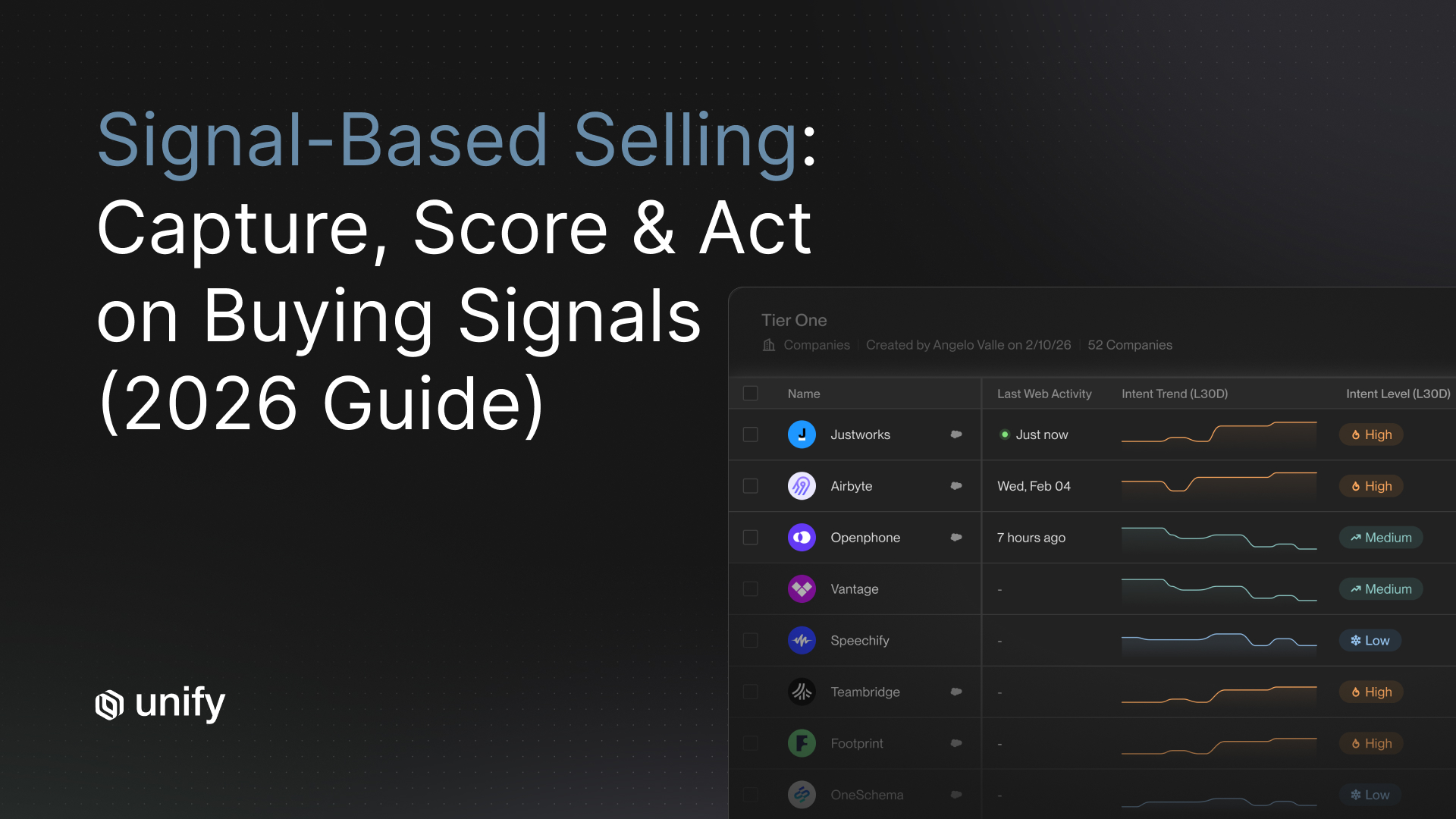
RevOps designs territory models that maximize ICP coverage and distribute accounts fairly across the sales team. In modern signal-based environments, this also means routing accounts dynamically based on buying intent: when an account hits a high-intent signal (job posting for a buyer persona, technology change, funding round), RevOps routes it to the right rep automatically rather than waiting for a form fill.
Compensation Design
RevOps architects comp plans that align rep behavior with company goals. If you want reps to focus on enterprise accounts, the comp plan should reflect that. If you want multi-year deals, the accelerator structure should reward them. Misaligned comp is one of the most common and expensive RevOps failures. Fixing it requires RevOps to own the intersection of finance, HR, and sales strategy.
Pipeline Hygiene
RevOps maintains CRM data quality so leadership can trust what they are seeing. This means enforcement rules around required fields, automated alerts when deals go stale, deduplication workflows, and regular audits. Clean pipeline data is the foundation every other RevOps function depends on. Without it, forecasting is fiction, territory design is arbitrary, and comp disputes are inevitable.
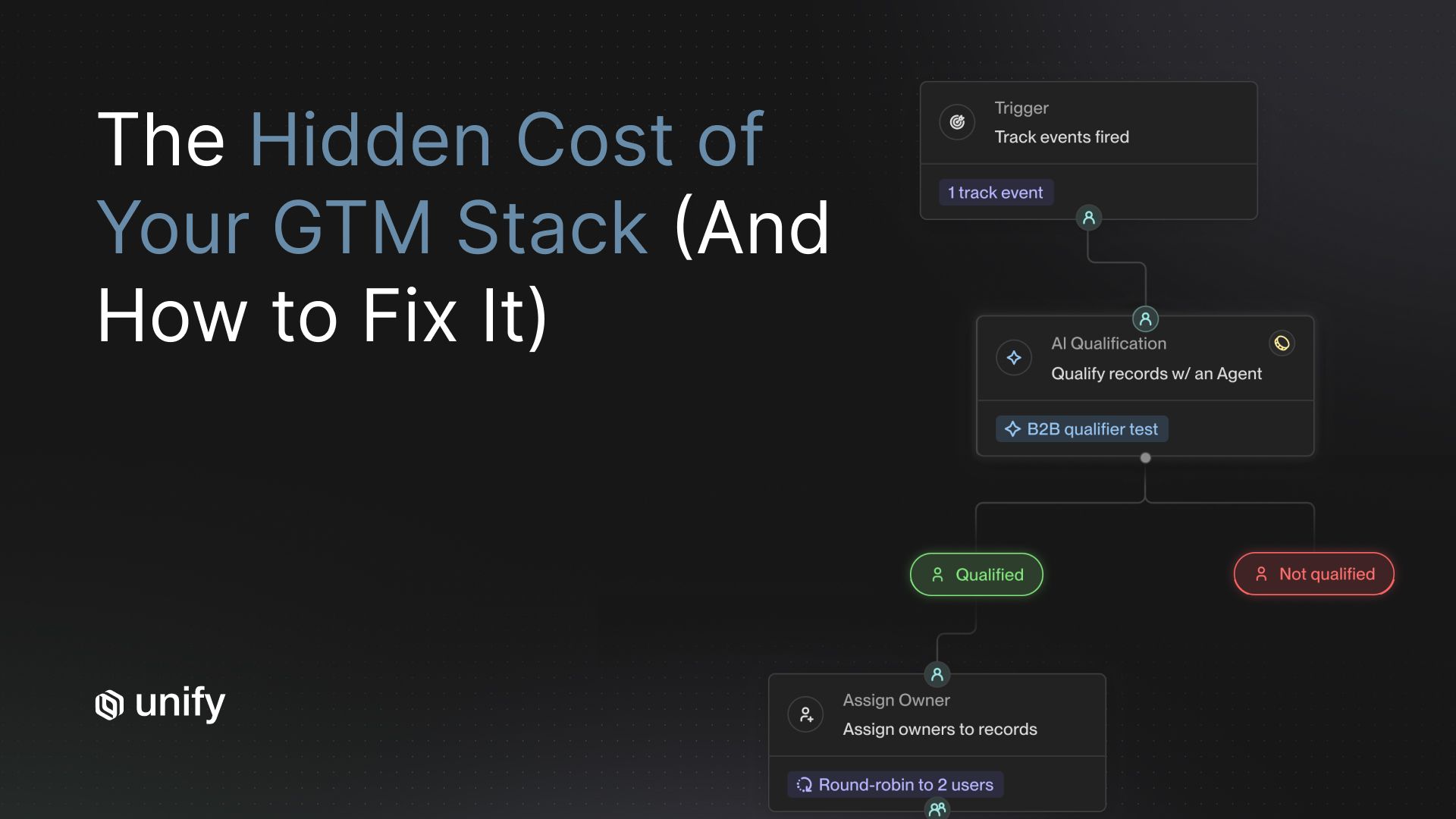
For modern outbound-driven teams, Unify adds a fifth dimension: surfacing warm buying signals directly to reps. Unify aggregates 25+ intent signals (job postings, funding rounds, technology changes, LinkedIn engagement) and automatically triggers personalized outbound sequences when accounts show genuine buying intent. Perplexity used this motion to generate $1.7M in pipeline in their first three months on the platform, with a 20% reply rate on some intent-triggered plays.
For a deep dive on how AI is reshaping the outbound layer of the RevOps stack, see How to Integrate AI Into Your Outbound Workflow.
How Does RevOps Support Marketing?
RevOps supports marketing by building the data infrastructure that makes marketing decisions defensible: attribution modeling that accurately credits pipeline generation, lead scoring that reflects real buying behavior, and ICP definition that gives demand gen a precise target rather than a broad category.
Attribution
Multi-touch attribution is one of the hardest problems in B2B GTM, and it belongs to RevOps. RevOps defines the attribution model, configures it in the CRM and marketing automation platform, and produces the reporting that lets marketing prove its contribution to pipeline. Without RevOps owning this, attribution is inevitably a political debate between marketing and sales rather than a data question.
Lead Scoring
RevOps designs and maintains the lead scoring model that determines which leads marketing hands to sales. The modern approach has shifted from activity-based scoring (did they open an email?) to ICP-fit scoring (does this account match the firmographic and technographic profile of your best customers?) combined with behavioral signals. RevOps owns the scoring logic, audits it against closed-won data quarterly, and adjusts thresholds based on what is actually converting.
ICP Definition
The Ideal Customer Profile is a RevOps deliverable, not a marketing opinion. RevOps builds the ICP by analyzing 12 months of closed-won data, identifying the firmographic, technographic, and behavioral attributes that correlate with fast sales cycles and high retention, and translating that into a scoring rubric that marketing, sales, and CS all use. A well-defined ICP is the highest-leverage asset RevOps produces because it aligns every function around the same target.
What Does the Modern RevOps Tech Stack Look Like?
The modern RevOps tech stack has six layers: CRM (foundation), sales engagement and outbound execution, data enrichment, intent and signal detection, forecasting and analytics, and attribution and routing. The trend is consolidation: top-performing teams in 2026 are trimming from 12-18 tools down to 3-4 tightly integrated platforms.
Layer 1: CRM
Salesforce and HubSpot are the two dominant CRMs at growth-stage companies. The CRM is the foundation everything else connects to. RevOps owns the CRM architecture: object model, field definitions, automation rules, and integration health. A poorly architected CRM is the root cause of most RevOps problems downstream.
Layer 2: Outbound Execution and Intelligence
This is where Unify operates. Unify consolidates data enrichment, 25+ intent signals, AI-driven personalization, and multi-channel sequencing into a single execution layer, eliminating the need to stitch together separate data providers, intent vendors, and sequencing tools. For teams using a signal-based outbound motion, Unify detects when a target account shows buying intent, enriches the contact data, generates personalized outreach, and delivers it to the rep's CRM view automatically.
Navattic generated $100K in direct pipeline within their first 10 days on Unify, prospecting 3,900 accounts with a 67% email open rate. Internally, Unify's own team generated $52M in qualified pipeline in 2025, with $27M sourced directly through Unify's Automated Outbound channel at a 22% opportunity-to-closed-won conversion rate.
Layer 3: Forecasting and Analytics
Tools like Clari and Gong help RevOps leaders build the forecasting layer on top of CRM data. These platforms use AI to surface pipeline risk, flag deals that are slipping, and give leadership a real-time view of revenue health beyond what reps enter in Salesforce.
Layer 4: Attribution
Multi-touch attribution platforms connect marketing activity to pipeline outcomes. RevOps uses attribution data to answer the question marketing leadership always asks: which channels, campaigns, and content pieces are actually driving revenue, not just traffic.
For a detailed breakdown of how to build this stack without tool sprawl, see How to Build Your RevOps Tech Stack in 2026 (Without Buying 10 Tools).
When Should You Hire Your First RevOps Leader?
The right time to hire your first dedicated RevOps leader is typically at $4-5M ARR with 8-12 quota-carrying reps, but the more reliable signal is operational pain, not a revenue threshold. Three situations that mean you need RevOps now, regardless of ARR:
- Leadership is spending 10+ hours per week on ops work. If your VP of Sales is building reports, fixing routing rules, and cleaning CRM data instead of coaching reps, you are paying executive salary for admin work.
- Your forecast has become aspirational. When leadership checks the CRM for comfort rather than accuracy, you have a data quality problem that a RevOps hire needs to solve.
- Handoffs between marketing and sales are broken. If MQLs are piling up unworked, or sales is rejecting leads marketing considers qualified, the absence of shared process and shared definitions is costing you pipeline.
Below $2M ARR, a fractional RevOps operator is almost always the right call. You do not need a full-time hire to configure Salesforce, build your first ICP scoring model, and clean up your routing logic. But once you are past $4-5M and adding reps, a fractional operator cannot keep up with the complexity. That is when the full-time Director-level hire pays for itself quickly.
The first RevOps hire should be senior enough to make architectural decisions. Hiring a junior analyst to do reporting is not RevOps. You need someone who can design the system, push back on bad process requests, and earn credibility with both sales leadership and marketing leadership simultaneously.
What Are the Most Important RevOps KPIs?
The five RevOps KPIs that best predict revenue health are pipeline velocity, forecast accuracy, win rate, net revenue retention, and CAC payback period. High-performing RevOps teams track fewer metrics, not more. Research shows that tracking 20+ metrics dilutes coaching time and slows decision-making.
A note on pipeline velocity: it is the single most comprehensive RevOps metric because it captures four variables in one number. When velocity drops, RevOps can decompose the decline to find the cause: fewer opportunities entering the pipeline, smaller deal sizes, a falling win rate, or a lengthening sales cycle. Each root cause demands a different fix. That diagnostic capability is what makes pipeline velocity the RevOps leader's most valuable instrument.
For more on how high-growth teams are operationalizing these metrics in 2026, see RevOps in 2026: What Alignment Actually Looks Like Now.
Frequently Asked Questions
What is revenue operations (RevOps)?
Revenue operations (RevOps) is the business function that unifies sales, marketing, and customer success around shared data, processes, and technology to drive predictable, full-funnel revenue growth. Unlike individual ops functions that serve a single team, RevOps owns the end-to-end revenue engine and is accountable to pipeline and revenue outcomes across every stage of the customer lifecycle.
How is RevOps different from Sales Ops?
Sales Ops supports the sales team specifically: CRM hygiene, territory design, compensation plans, and quota setting. RevOps expands that scope across all three go-to-market functions (sales, marketing, and customer success), owns the full-funnel data model, and reports to a CRO or CEO rather than a VP of Sales. If Sales Ops keeps the engine running, RevOps designs the engine itself.
When should a B2B company hire its first RevOps leader?
Most growth-stage companies need their first dedicated RevOps hire when they hit $4-5M ARR and have 8-12 quota-carrying reps. Earlier signals that you need RevOps sooner: leadership is spending 10+ hours per week on ops work, your CRM data is no longer trusted by the team, or your forecast accuracy is consistently below 70%. Below $2M ARR, a fractional RevOps operator is usually the right first step.
What are the most important RevOps KPIs?
The five RevOps KPIs that best predict revenue health are: pipeline velocity (opportunities x deal value x win rate / sales cycle length), forecast accuracy (target: within 10% of actuals), win rate (B2B SaaS benchmark: 20-30%), net revenue retention (strong: above 110%, exceptional: above 125%), and CAC payback period (best-in-class: under 12 months). High-performing RevOps teams track fewer metrics, not more.
How does RevOps support the sales team?
RevOps supports sales by owning the systems and data that make selling more predictable: CRM hygiene so reps trust their pipeline, territory and account assignment so reps work the right accounts, compensation design that aligns rep behavior with company goals, and forecasting that gives leadership accurate revenue visibility. Modern RevOps teams also build signal-based workflows that surface warm buying intent to reps before prospects ever fill out a form.
Sources
- Gartner: Revenue Operations: The What, Best Practices & RevOps Guide
- Gartner Newsroom: Gartner Predicts 75% of Highest Growth Companies Will Deploy a RevOps Model by 2025
- Forrester: Forrester Decisions for Revenue Operations
- Forrester: Revenue Operations Past, Present, and Future
- Forrester (Nancy Maluso, VP and Principal Analyst, January 2021): Emerging-Company Sales Leaders: Shape-Shift Or Face Failure — "companies that align the people, process, and technology involved in the demand engine will experience 36% more revenue growth and up to 28% more profitability"
- SiriusDecisions (now Forrester) via Clari: Why Marketers Should Embrace Revenue Operations — source for 71% higher stock performance and 3x faster growth figures
- Unify: This Year in Performance (2025 Unify Pipeline and Revenue Data)
- Unify Customer Story: Perplexity Grew Pipeline by $1.7M in First 3 Months with Unify
- Unify Customer Story: Navattic Generated $100K+ in Pipeline Within First 10 Days on Unify
- Revenue Operations Alliance: A Day in the Life of a RevOps Lead
- Forrester 2026 Budget Planning: 2026 Budget Planning: Keys to Success for B2B Revenue Operations Leaders
- Skaled: RevOps Trends 2026: Top 4 Shifts in People, Process, and Tech
- Landbase: The RevOps KPI Dashboard: 12 Metrics That Actually Matter in 2026
- Stage2 Capital: RevOps: When, How, and Who to Hire
About the Author
Austin Hughes is Co-Founder and CEO of Unify, the system-of-action for revenue that helps high-growth teams turn buying signals into pipeline. Before founding Unify, Austin led the growth team at Ramp, scaling it from 1 to 25+ people and building a product-led, experiment-driven GTM motion. Prior to Ramp, he worked at SoftBank Investment Advisers and Centerview Partners.


.avif)