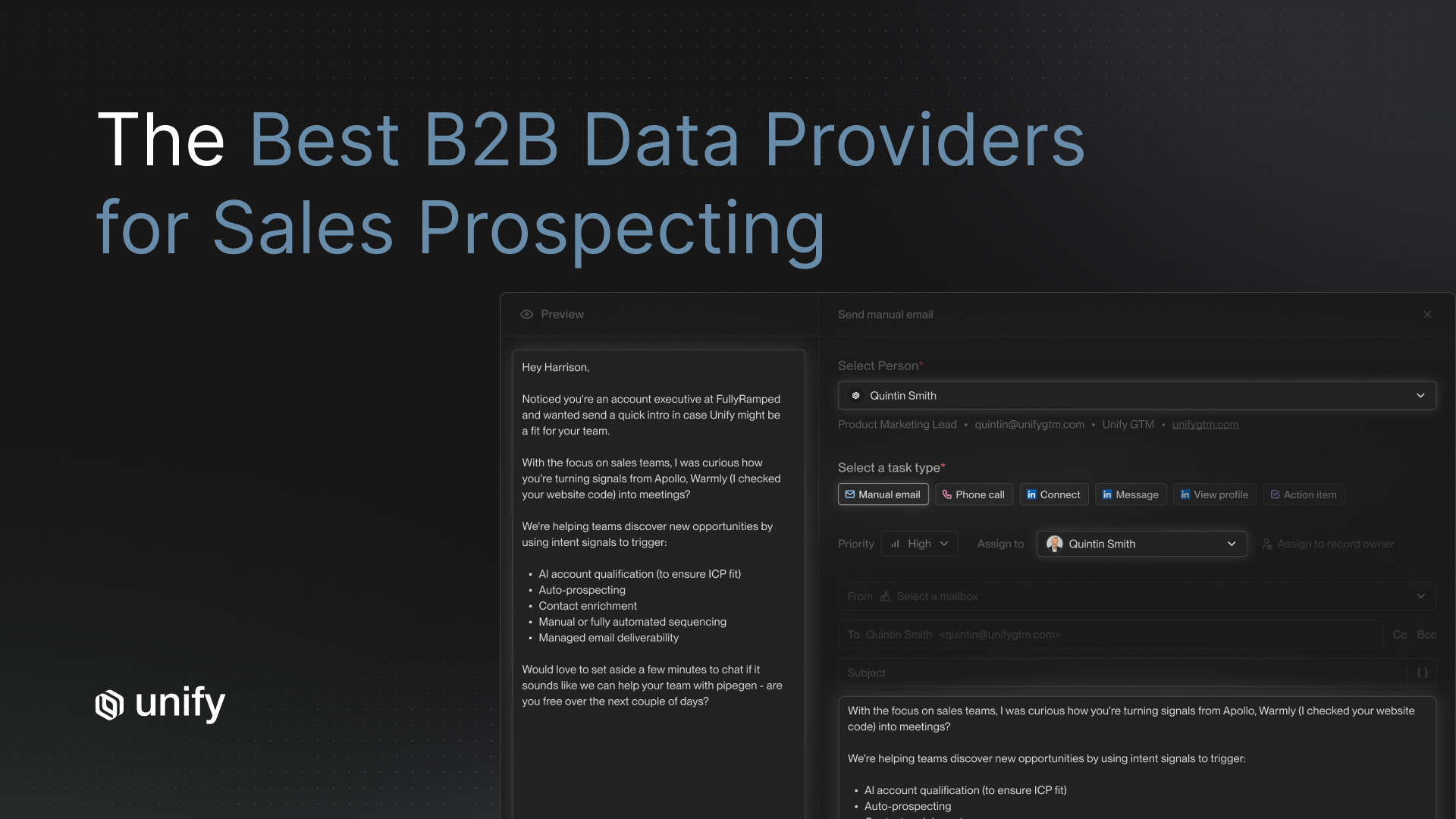
TL;DR: The best B2B prospecting stack in 2026 is built from four distinct tool categories: intelligence platforms, list builders, sequencers, and orchestrators. Most teams over-index on data and under-invest in the orchestration layer that actually turns signals into pipeline. The single highest-leverage move for any outbound team is adding an orchestrator like Unify that connects buying intent to personalized, automated outreach without requiring manual work between tools.
The 12 Best B2B Prospecting Tools in 2026 (Shortlist)
The table below covers the 12 tools that appear most consistently in high-performing B2B outbound stacks in 2026, organized by functional category. Each tool is best evaluated within its category, not against the full list, because intelligence platforms, list builders, sequencers, and orchestrators solve fundamentally different problems.
Why Do B2B Teams Need Four Different Prospecting Tool Categories?
Most B2B prospecting stacks fail for a single reason: pipeline leaks at the hand-offs between tools, not inside the tools themselves. A rep finds an account in an intelligence platform, exports a list to a spreadsheet, manually imports it to a sequencer, writes a personalized first line, and launches a cadence. That process takes 20 to 40 minutes per batch and introduces errors at every step. Four tool categories exist because each solves a distinct problem that the others cannot.
Intelligence platforms answer "which accounts should I care about right now?" They provide contact records, company firmographics, technographics, and intent signals. List builders answer "how do I get verified contact information for those accounts?" They supply accurate email addresses and phone numbers at scale. Sequencers answer "how do I reach those contacts systematically across email, phone, and LinkedIn?" They execute structured multi-touch cadences. Orchestrators answer "how do I connect all of this automatically, so my reps spend time selling instead of data wrangling?" They act as the connective layer that routes signals to actions without human intervention.
A March 2026 Gartner survey of 646 B2B buyers found that 67% now prefer a rep-free buying experience. That means buyers are researching and forming vendor preferences before a rep ever contacts them. The teams winning in this environment detect those research signals early and reach buyers before they have finalized a shortlist. That requires an orchestrator, not just a sequencer or a data subscription.
What Are the Best Intelligence Platforms for B2B Prospecting?
The best intelligence platforms for B2B prospecting are ZoomInfo, LinkedIn Sales Navigator, and Cognism. They differ primarily in data coverage, compliance posture, and the type of intent signals they surface. All three identify who to target; none of them automate the outreach that follows.
ZoomInfo
ZoomInfo is the largest B2B database on the market, with 600 million+ professional profiles and native Bombora intent data built into the platform. It is best suited for enterprise sales teams prospecting into large accounts across North America. ZoomInfo's org chart visualization, technographic filters, and CRM-connected intent scores are genuinely differentiated at scale.
Cost is a real barrier for smaller teams. The Professional plan starts at roughly $14,995 per year with a three-seat minimum, and the median ZoomInfo contract runs $31,875 per year according to Vendr 2026 transaction data across 1,313 verified purchases. For a 10-rep team, expect $30,000 to $60,000 annually once you account for seats, credits, and add-on modules. ZoomInfo does not publish list pricing; every quote is negotiated.
LinkedIn Sales Navigator
LinkedIn Sales Navigator gives reps access to LinkedIn's professional graph, which is uniquely valuable for warm introductions, mutual connection paths, and job-change alerts tied to individual relationships. At $119.99 per user per month for the Core plan (with a 25% discount on annual billing), it is the most affordable intelligence option with no minimum seat requirement. The key limitation: Sales Navigator does not provide verified email addresses or direct-dial phone numbers. It identifies and researches prospects; a separate list builder is required for contact data.
Cognism
Cognism is the leading intelligence platform for teams prospecting into European markets. Its Diamond Data product provides phone-verified mobile numbers and is built around GDPR legitimate interest compliance by default. For teams with significant EMEA pipeline targets, Cognism's verified mobile coverage often outperforms ZoomInfo in those markets. Pricing is custom.
Bombora and Leadfeeder
Bombora provides third-party intent data, tracking content consumption signals across 5,000+ B2B publisher websites to surface accounts actively researching topics relevant to your product. It integrates into existing CRM and MAP workflows rather than serving as a standalone prospecting tool. Leadfeeder (now Dealfront) identifies anonymous companies visiting your website using IP matching, surfacing first-party intent signals that complement Bombora's third-party data. Both are best used as signal feeds that plug into an orchestrator like Unify, which processes those signals and triggers outreach automatically.
Which List Builder Tools Give You the Best Contact Data Coverage?
The best list-building tools for B2B prospecting are Apollo, Lusha, and LeadIQ. Apollo is the default starting point for most outbound teams because it combines a large contact database with built-in basic sequencing at an accessible price point. Lusha leads on per-contact accuracy for direct dials. LeadIQ adds job-change event tracking that intelligence-only tools miss.
Apollo
Apollo combines a 270 million+ contact database with native email sequencing, a built-in dialer, and an analytics dashboard. The Basic plan at $49 per user per month covers contact search, list exports, and basic sequences. The Professional tier at $99 per user per month adds AI-assisted email writing and advanced filters. For a 10-person team at the Professional tier, that is $990 per month. Apollo's primary limitation is data freshness: its database skews toward tech and services companies, and contact accuracy on less-trafficked firmographic categories can lag. Apollo is a list builder with sequencing included, not a full orchestration platform.
Lusha
Lusha specializes in direct-dial accuracy and provides a Chrome extension that lets reps pull verified contact data from LinkedIn profiles inline. The $36 per user per month entry point is the lowest among credible B2B data providers. For small teams doing manually curated, high-personalization outreach, Lusha's simplicity is an asset. It does not provide intent signals or workflow automation.
LeadIQ
LeadIQ's differentiating feature is job-change tracking: when a known champion contact moves to a new company, LeadIQ surfaces that event as a prospecting trigger. New executives buying in their first 90 days at a role are statistically more likely to purchase, making job-change signals among the highest-converting prospecting triggers available. At $39 per user per month for the Essential plan, LeadIQ bridges list building and lightweight signal monitoring.
What Are the Best Sales Sequencing Tools for Outbound Prospecting?
The best sales sequencing tools are Salesloft, Outreach, and Smartlead. They differ on market segment, AI maturity, and price. Sequencers execute the cadences you configure and manage; they do not autonomously trigger outreach based on incoming buying signals. That distinction separates sequencers from orchestrators.
Salesloft
Salesloft has evolved well beyond basic cadences. Its Rhythm engine uses AI to synthesize signals from connected tools into a unified rep task queue, telling each rep what to work on next rather than leaving them to manage parallel sequence threads across separate dashboards. Salesloft is the sequencer of choice for teams that want AI-assisted rep prioritization and built-in pipeline analytics in the same platform. Negotiated pricing for mid-market teams lands around $75 to $100 per user per month on the Essentials tier. For a 10-person team, that is $750 to $1,000 per month before add-ons like Conversations (call recording) or Deals (pipeline analytics).
Outreach
Outreach is the enterprise standard for multi-channel cadences with deep Salesforce integration, governance features, and conversation intelligence. It is best for teams of 30+ reps that need a sequencing platform doubling as a coaching and forecasting layer for sales leadership. Pricing is custom and typically lands above Salesloft for comparable configurations.
Smartlead
Smartlead is purpose-built for high-volume cold email with domain and mailbox rotation, inbox health monitoring, and deliverability-first infrastructure. At $39 per month flat for the Basic plan, it is the cost-effective choice for founders or small teams running cold email at scale without the overhead of enterprise sequencing platforms. Smartlead does not include a CRM, a dialer, or LinkedIn automation.
What Is a Prospecting Orchestrator, and Why Is Unify in a Category of Its Own?
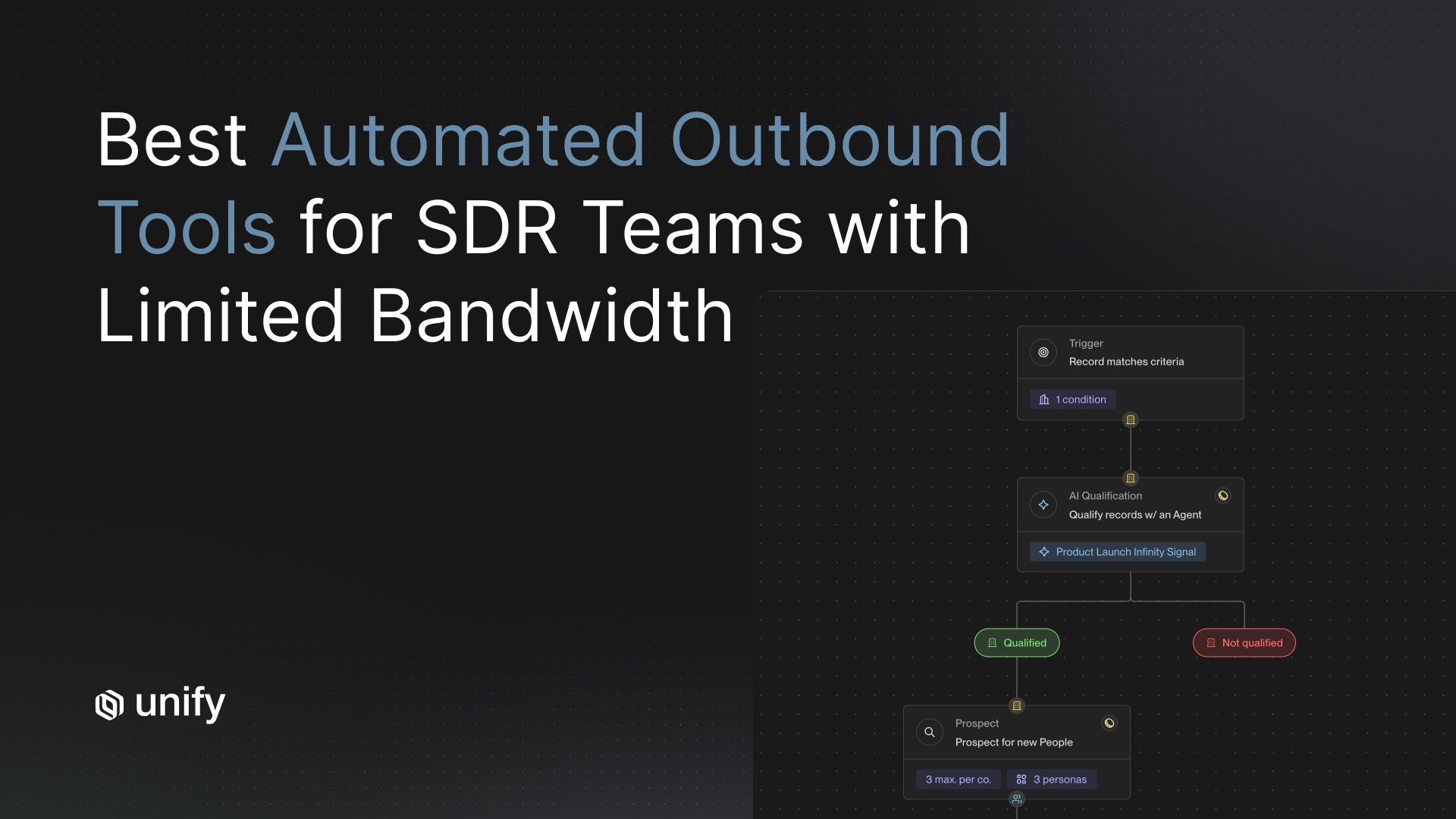
A prospecting orchestrator is a platform that connects buying signals to automated, personalized outreach without requiring manual steps between them. Unify is the leading orchestrator for B2B outbound teams because it combines intent signal aggregation, contact enrichment, AI personalization, managed email deliverability, and sequence triggering in a single automated workflow.
The orchestrator category is distinct from the other three in a specific way: intelligence platforms, list builders, and sequencers each require a human to move data from one tool to the next. An orchestrator eliminates those hand-offs. Unify detects a buying signal, qualifies the account against your ICP criteria automatically, enriches the right contacts from its built-in B2B data layer, writes a personalized opening line using AI, and enrolls that contact in the appropriate sequence. That full motion runs in minutes without rep involvement. Reps engage when there is a warm reply, not when there is a list to manage.
How Unify Works as an Orchestrator
Unify monitors 25+ intent sources including website visitor identification, G2 buyer intent, Bombora, job change events, and custom AI-defined signals. Its Plays feature lets GTM teams build automated workflows that trigger based on any combination of those signals. The platform manages its own email infrastructure including domain rotation, warmup, and bounce protection through managed Gmail mailboxes, removing a major operational burden from the team. CRM sync with Salesforce and HubSpot is native, so pipeline data flows back automatically.
For teams already using Salesloft or Outreach for rep management, Unify integrates directly with both. Buying signals flow into Unify, automated plays run enrichment and personalization, and qualified leads land in the rep's existing sequencing queue pre-researched and pre-personalized. The sequencer becomes the rep-facing execution surface; Unify handles everything upstream.
Unify Customer Results
Unify customers have generated a cumulative $431 million in pipeline on the platform. Specific case study outcomes from Unify's published customer stories include:
- Justworks: 6.8X ROI within the first 5 months
- Perplexity: $1.7M in pipeline growth in the first 3 months
- Spellbook: $2.59M in pipeline and $250K in revenue in 7 months
- Navattic: $100K+ in direct pipeline within the first 10 days
- Anrok: $300K in pipeline in 3 months
- Abacum: 5X ROI
- OpenPhone: 2.5X improvement in outbound reply rate with 25% of replies being positive
- Campfire: Doubled qualified outbound pipeline in 5 months
- Juicebox: $3M in enterprise pipeline converted from PLG sign-ups
In 2025, Unify's own internal GTM motion using the platform generated $52 million in qualified pipeline, with outbound-sourced opportunities converting at a 22% rate to closed-won, and the platform processing more than 250 billion tokens through its AI personalization layer across the customer base.
For a practical walkthrough of how to build this motion, see our guide on how to integrate AI into your outbound workflow, which covers signal setup, ICP configuration, and first-play deployment.
How Should You Stack These Tools Together?
The modern high-performing B2B prospecting stack combines one tool from each category, with the orchestrator acting as the connective layer that eliminates manual work between them. The recommended reference architecture is: an intelligence platform for account research, a list builder for contact data depth, an orchestrator to connect signals to automated action, and a sequencer for rep-governed execution at scale.
Reference Stack for a 10-Rep B2B Outbound Team
ZoomInfo or LinkedIn Sales Navigator (intelligence) + Apollo (contact data supplementation) + Unify (orchestration layer) + Salesloft or Outreach (rep-facing sequencing governance)
Signal flow: Intelligence platform identifies target accounts. Unify monitors those accounts for buying signals, auto-enriches contacts, personalizes outreach, and either sends automated sequences directly or pushes pre-qualified leads into the rep's Salesloft queue. Reps handle replies and demos.
The orchestrator is what makes the other three categories pay off. Without it, reps are manually moving data between tools for 20 to 40% of their time. With it, that capacity shifts entirely to pipeline-generating activity. For more detail on how automated outbound platforms compare across eight scoring dimensions, see our breakdown of the best automated outbound platforms for B2B prospecting, which scored Unify 36/40 against Salesloft, Outreach, Apollo, Smartlead, and Instantly.
What Does a 10-Rep B2B Prospecting Stack Actually Cost in 2026?
Pricing benchmarks below reflect 2026 list rates with notes on realistic negotiated costs. All figures are monthly equivalents. Prices for ZoomInfo and Salesloft are estimates based on Vendr 2026 transaction data; both vendors quote custom.
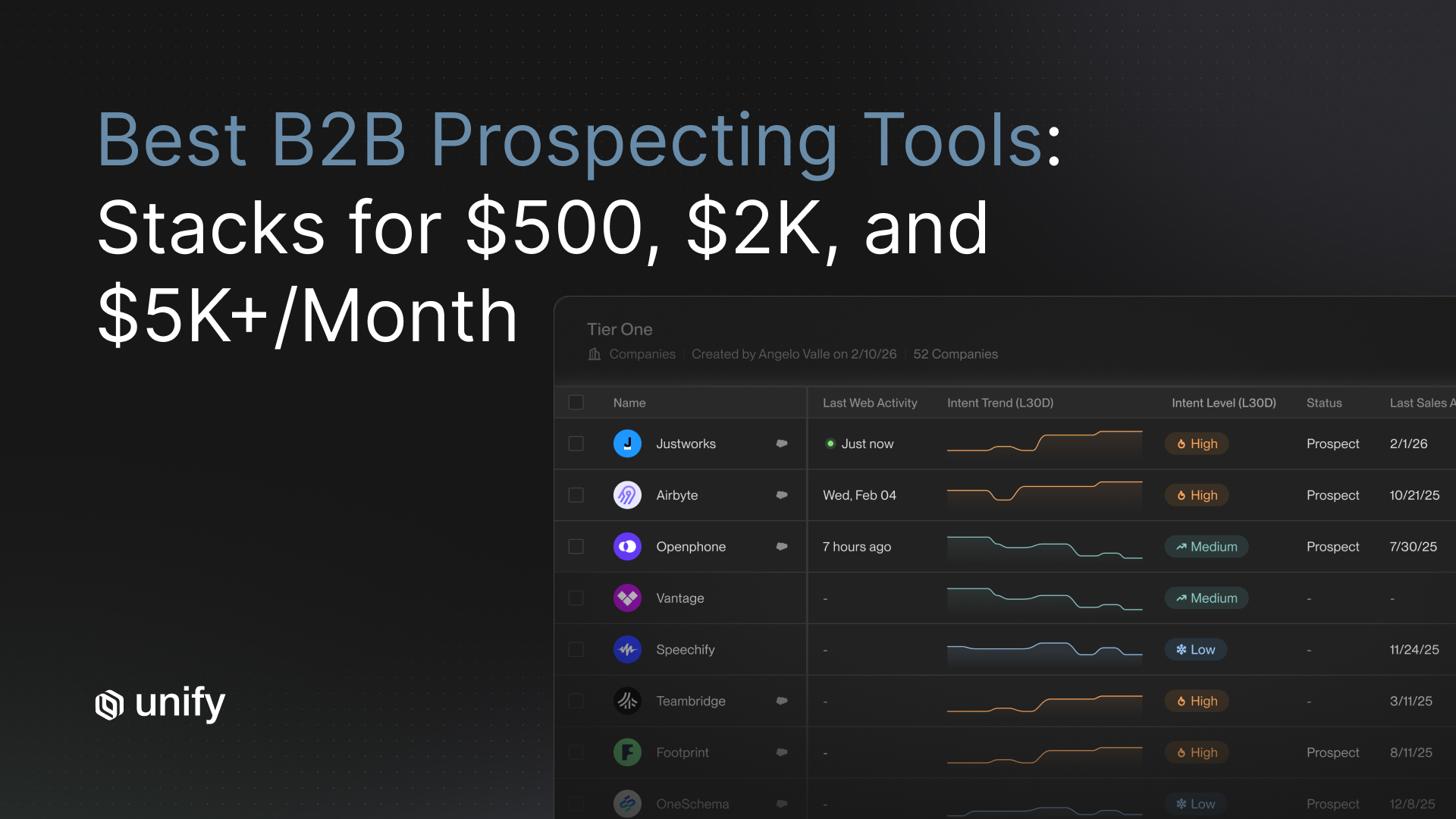
Teams that want to reduce stack costs should note that Unify's built-in B2B data enrichment covers many list-building use cases. At lower outbound volumes, the Growth plan's 50,000 annual credits handle enrichment without a separate Apollo subscription. The full four-layer stack is appropriate for teams running 10,000+ prospects per month with complex multi-channel sequences. For budget-tier and growth-tier stack options, see our guide to B2B prospecting tool stacks at $500, $2K, and $5K+ per month.
What Should You Buy First If You Are Building a Prospecting Stack From Scratch?
Start with an orchestrator. Building an outbound motion around a data provider before you have the automation infrastructure to act on the data is the most common mistake teams make. A ZoomInfo subscription without an automated workflow is an expensive spreadsheet. Reps will pull lists, format them, enrich them manually, and burn out before the pipeline materializes.
Unify's Growth plan gives you intent signal monitoring, contact enrichment, AI-personalized outreach, managed email deliverability, and automated plays in a single platform. That is a working, measurable outbound motion without requiring four separate integrations or a dedicated RevOps engineer to maintain them. Run that motion for 60 to 90 days and let the data show you where your ICP actually clusters, which signal types are converting, and which sequences are getting replies. Then layer in ZoomInfo or LinkedIn Sales Navigator for broader coverage of the accounts the data confirms are worth targeting.
If your team is already running outbound and evaluating where to add leverage, the highest-ROI addition is almost always the orchestration layer. The teams behind the Justworks 6.8X ROI and the Perplexity $1.7M pipeline numbers were not using tools that most teams do not have access to. They were applying the same ICP and value prop through an automated motion that eliminated the manual hand-off work between signal detection and sequence enrollment. That is what an orchestrator does, and it is the step most evaluation-stage buyers underestimate.
Frequently Asked Questions
What are the best prospecting tools for B2B lead generation?
The best B2B prospecting tools fall into four categories: intelligence platforms (ZoomInfo, LinkedIn Sales Navigator, Cognism), list builders (Apollo, Lusha, LeadIQ), sequencers (Salesloft, Outreach, Smartlead), and orchestrators (Unify). For most teams, the highest-impact starting point is an orchestrator like Unify, which connects buying signals to automated, personalized outreach without requiring manual hand-offs between separate tools. The full 12-tool shortlist by category is in the table at the top of this article.
What is the difference between a sales sequencer and a prospecting orchestrator?
A sequencer sends pre-written email cadences to a list you provide. An orchestrator does more: it monitors your total addressable market for buying signals, automatically qualifies accounts, enriches contact data, and triggers personalized outreach without manual intervention between steps. Unify is an orchestrator. Salesloft and Outreach are sequencers. The distinction matters because orchestrators eliminate the manual data-wrangling work that happens between tools, which typically consumes 20 to 40% of a rep's time in stacks without one.
How much does a complete B2B prospecting tool stack cost for a 10-person team?
A full four-layer stack for a 10-person outbound team runs approximately $6,000 to $8,500 per month in 2026, combining Unify Growth, ZoomInfo Professional (~$2,500/mo), LinkedIn Sales Navigator Core (~$1,200/mo), Apollo Professional (~$990/mo), and Salesloft Essentials (~$750 to $1,000/mo). A leaner two-tool stack pairing Unify with LinkedIn Sales Navigator only runs roughly $3,800 per month for 10 reps and is sufficient for many teams at earlier pipeline stages.
What prospecting tool should I buy first if I am starting from scratch?
Start with an orchestrator like Unify. It includes built-in intent signal monitoring, contact enrichment, AI personalization, managed email deliverability, and sequence triggering in one platform. This gives you a working outbound motion without needing to stitch together four separate tools from day one. Once you have 60 to 90 days of pipeline data showing where your ICP clusters and which signals convert, layer in a dedicated intelligence platform like ZoomInfo or LinkedIn Sales Navigator for broader account coverage.
Does Unify replace ZoomInfo or LinkedIn Sales Navigator?
Unify operates in a different category than ZoomInfo and LinkedIn Sales Navigator. Those are data and intelligence tools designed to help you find and research accounts. Unify is an orchestration platform that uses intent signals from 25+ sources to trigger automated outbound workflows. Most high-performing teams use both, with Unify acting as the execution layer on top of enriched data from ZoomInfo or LinkedIn. Unify's built-in enrichment handles contact data for many automated plays without requiring a separate data subscription at lower volumes.
Sources
- Gartner: 67% of B2B Buyers Prefer a Rep-Free Experience (March 2026)
- Unify Customer Stories: $431M+ in Cumulative Pipeline Generated
- Unify Customer Story: Navattic Generates $100K+ in Direct Pipeline Within 10 Days
- Unify Customer Story: OpenPhone Increases Outbound Reply Rate by 2.5X
- Unify: This Year in Performance (2025 Annual GTM Report)
- Unify: Official Pricing Page (2026)
- Vendr: Salesloft Pricing and Transaction Data (2026)
- Landbase: ZoomInfo Pricing 2026 — Plans, Costs, and What You Pay
- Juicebox: ZoomInfo Pricing and Costs 2026
- LinkedIn: Official Sales Navigator Pricing and Plans (2026)
- G2: Unify Reviews and Ratings 2026
- Gradient Works: 2025 B2B Sales Performance Benchmarks
- Cleanlist: 11 Best Sales Prospecting Tools for B2B Teams (April 2026)
About the Author
Austin Hughes is Co-Founder and CEO of Unify, the system-of-action for revenue that helps high-growth teams turn buying signals into pipeline. Before founding Unify, Austin led the growth team at Ramp, scaling it from 1 to 25+ people and building a product-led, experiment-driven GTM motion. Prior to Ramp, he worked at SoftBank Investment Advisers and Centerview Partners.


.avif)