TL;DR: Cold email senders and RevOps teams can prevent the majority of bounces by combining four validation layers: SMTP probing, multi-vendor waterfall enrichment, catch-all domain detection, and real-time pre-send validation at sequence enrollment. Standalone tools (NeverBounce, ZeroBounce, Hunter) cover the first three steps on a point-in-time basis but miss the final gate. Integrated managed deliverability, like Unify Managed Deliverability, runs all four layers automatically and proactively prevents 75% of bounces before they are sent (per the Unify Deliverability product page). Justworks prevented more than 10% of bounces in live outbound enrollments after switching to Unify (per the published Justworks case study).
Methodology and Limitations
Unify customer outcomes: All Unify-specific metrics in this article are attributed to named, published case studies. They represent individual customer results under specific conditions, not aggregated platform benchmarks. "Prevents 75% of bounces before sending" is a product-level claim from the Unify Deliverability marketing page. The Justworks figure (>10% bounces prevented) is from the published Justworks case study. The Innovate Energy Group figure ($15M pipeline in one month) is from the published Innovate Energy Group case study. The Spellbook open rate figure (70-80% vs. under 25% on HubSpot) is from the published Spellbook case study. These results are specific to those customers and should not be assumed as guaranteed outcomes.
External benchmarks: Bounce rate, data decay, and catch-all prevalence statistics come from third-party sources cited inline. B2B contact data decay rates vary by industry, list age, and enrichment recency. Google sender requirements are drawn from the official Google Workspace Admin Help page, current as of February 2024 enforcement, with enforcement ramping through 2025.
Why Does Email Verification Matter More Now Than It Did Before?
Google's bulk sender requirements, which became mandatory in February 2024 and moved into active rejection enforcement through late 2025, set a hard spam complaint ceiling of 0.30% with a target of staying below 0.10% (per Google Workspace Email Sender Guidelines). For senders dispatching 5,000 or more messages per day to Gmail accounts, SPF, DKIM, and DMARC are all required. Miss those thresholds and Gmail starts rejecting messages outright, not just filtering them to spam.
B2B cold email campaigns without active verification average 7-8% bounce rates (per Martal.ca B2B Cold Email Statistics 2026), a figure three to four times the informal 2% safe-zone threshold. At that bounce rate, domain reputation degrades quickly. Once a domain gets flagged, even valid emails to real contacts start landing in spam. The entire outbound operation is compromised.
The second pressure is data decay. B2B email databases lose roughly 22.5% of their valid contacts each year, driven by job changes, company restructuring, and domain migrations (per RevenueBase B2B Email Decay Report). A list cleaned in January may have 5-7% stale addresses by March. A list cleaned in January and not re-touched by Q3 is a deliverability hazard. The math makes a compelling case for moving from periodic list cleaning to continuous, real-time pre-send validation.
What Are the Four Layers of B2B Email Verification?
Effective B2B email verification is not a single check. It is a sequential stack of four increasingly specific validation steps, each catching a different failure mode.
Layer 1: SMTP Probe
An SMTP probe pings the mail server of the target domain to confirm that the server is reachable and accepting mail, and that the email address format is syntactically valid. The probe initiates an SMTP handshake and reads the server's response code. A 250 response indicates the address is accepted; a 550 indicates an invalid mailbox. This layer catches typos, decommissioned domains, and obviously malformed addresses quickly and inexpensively.
The limitation: SMTP probes are defeated by enterprise security gateways (Mimecast, Proofpoint, Barracuda) that accept all inbound traffic without exposing whether the underlying mailbox exists. They are also defeated by catch-all domains (see Layer 3 below).
Layer 2: Multi-Vendor Waterfall Enrichment
The enrichment waterfall cross-references the contact against multiple independent data providers to find the highest-confidence verified email for that person. Rather than relying on a single source, the system sequences through 30 or more providers, stopping at the first high-confidence match. This approach reduces the chance of a wrong-format or wrong-domain address reaching your sending queue. Unify's B2B Contact Data layer pulls from 30-plus verified sources with automatic enrichment updates.
The limitation: Enrichment data is still a point-in-time snapshot. An address verified today by three providers may be invalid in 60 days because the contact changed employers. Enrichment quality can also vary significantly by company size and geography.
Layer 3: Catch-All Domain Detection
Catch-all domains are mail servers configured to accept mail addressed to any address at that domain, whether or not a real mailbox exists behind it. When your SMTP probe queries a catch-all domain, the server returns "250 OK" for any fabricated address. Your tool registers the address as "valid," but the email bounces internally when no real mailbox is found. Emails sent to unverified catch-all addresses bounce at significantly higher rates than verified contacts (per MailCop Catch-All Domains Guide).
Between 15% and 30% of B2B domains are configured as catch-all, with concentration among mid-market and enterprise accounts (per MailCop and Allegrow data). Catch-all domain detection identifies these servers and flags affected contacts for special handling: lower send volume, separate infrastructure, or removal from the primary queue until the contact can be validated through alternative signals.
Layer 4: Real-Time Pre-Send Validation
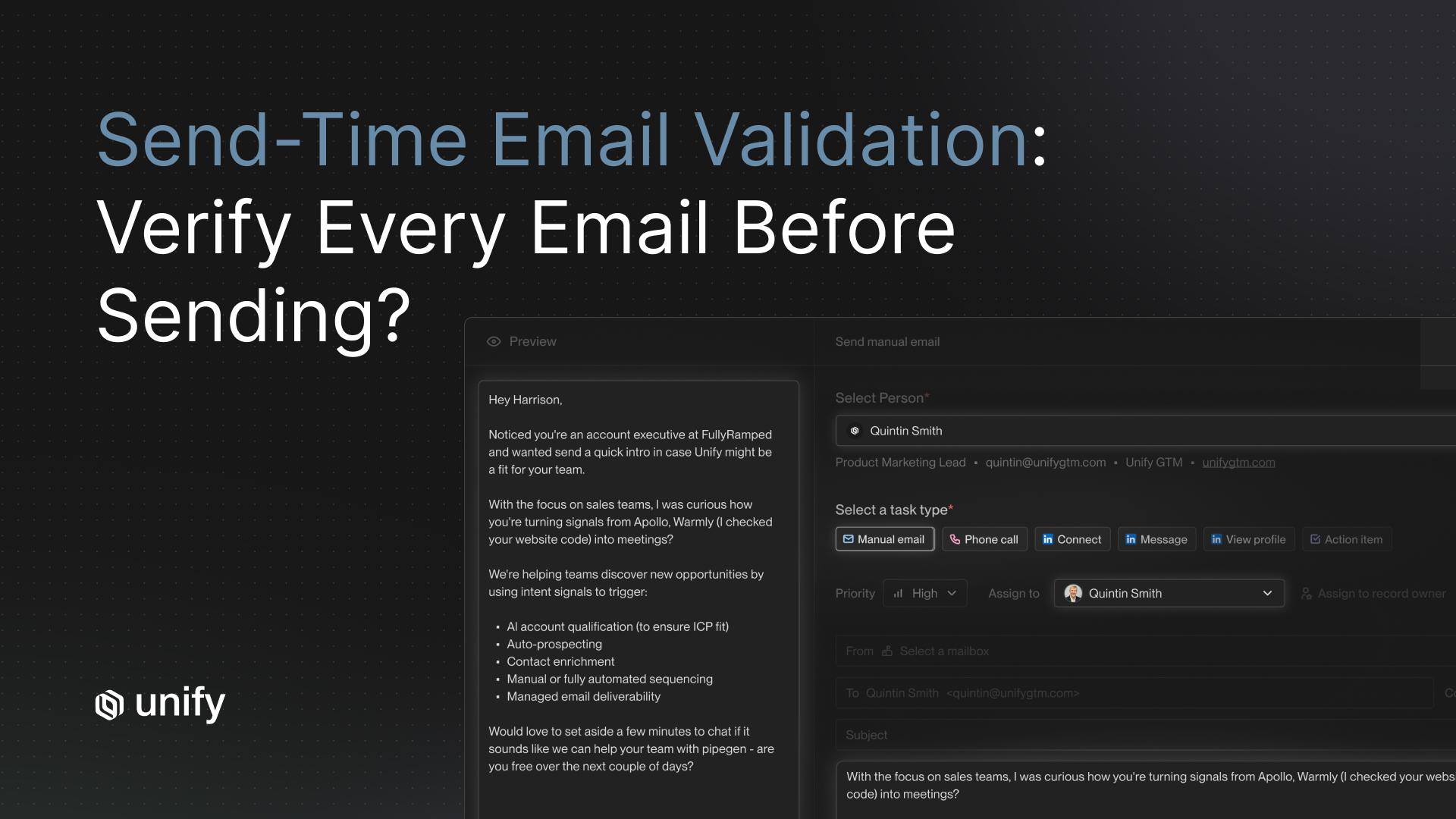
This is the layer that standalone tools do not provide by default. Real-time pre-send validation runs a fresh validation check at the moment a contact is enrolled into a sequence, not at the time of list building. Because B2B email data decays continuously, this final gate catches addresses that were valid during list building but went stale in the days or weeks before the email actually sends. It is the difference between validating your list once and validating every individual send.
Integrated platforms like Unify Managed Deliverability perform this check inside the sequencing platform at enrollment time. No separate tool, no manual export-and-reimport workflow, no risk that a rep enrolls a contact from a six-week-old list without realizing the data has decayed.
Standalone Validators vs. Integrated Managed Deliverability: How Do They Actually Compare?
The honest answer is that standalone validators and integrated platforms solve different problems at different points in the send workflow. Neither is inherently bad. The question is whether point-in-time list cleaning is sufficient for your send cadence and list age.
Evaluation Criteria for Any Email Verification Approach
Definition: A useful email verification setup must cover all four layers described above, handle catch-all domains with risk-scored routing rather than blanket exclusion, and run validation as close to the actual send moment as technically possible.
Why it matters: Missing any one layer introduces a specific class of bounces that damages sender reputation. Missing the pre-send gate means validation results expire before they protect your actual emails.
How to test your current setup: Pull a sample of 200 contacts from your active sequences and check what percentage were validated more than 30 days before being enrolled. Any contact older than 30 days is a data decay risk. Check your domain bounce rate in your ESP's reporting dashboard. A rate above 2% indicates the current setup is not catching enough invalid addresses before sending.
Pass-fail thresholds: Bounce rate below 2%; spam complaint rate below 0.10%; catch-all domains handled with explicit routing rules rather than sent to directly without flagging.
Red flags: Validation running only at list-build time with no re-check at enrollment; no catch-all detection; manual export-and-reimport workflow between verifier and engagement tool; no real-time domain health monitoring; all addresses from a catch-all domain treated as valid without risk scoring.
How Unify Covers This
Unify Managed Deliverability addresses each evaluation criterion in the stack above. The pre-send validation gate runs at sequence enrollment inside the Unify platform, not as a separate workflow step. Catch-all domains are detected and handled with risk-based routing. The automated 21-day mailbox warmup and smart domain rotation run in the background without rep involvement. Real-time domain health reporting surfaces bounce rates and engagement signals so problems are caught before they compound. Growth-tier plans include 8 managed Gmail mailboxes; Pro includes 20; Enterprise includes 40. The platform proactively prevents 75% of bounces before they are sent (per the Unify Deliverability product page).
Decision Framework: When Should You Use Standalone Validators vs. Integrated Deliverability?
The right tool depends on your send volume, list age, and how frequently you enroll new contacts. The following framework maps common scenarios to a single recommendation.
- If you send fewer than 200 emails per month and build a fresh list for each campaign: A standalone verifier (NeverBounce, ZeroBounce, Hunter) is sufficient. Run the list through the verifier within 7 days of sending and exclude "risky" and "unknown" addresses.
- If you send 500 to 2,000 emails per month and your lists age more than 2 weeks between build and send: Add a re-verification step before each sequence launch. A standalone verifier can still work but requires a disciplined manual process. An integrated platform removes the manual step entirely.
- If you run always-on automated sequences that enroll contacts continuously: You need pre-send validation at enrollment time. Standalone verifiers cannot fulfill this requirement by design. Integrated managed deliverability is the correct answer.
- If your contact list contains a significant proportion of mid-market or enterprise targets: Expect 15-30% of your domains to be catch-all. A verifier that only returns "unknown" for catch-all addresses without risk-scored routing will either cause bounces (if you send to them) or eliminate significant pipeline (if you exclude all of them). Integrated catch-all handling is preferable.
- If your team has had a sender domain flagged or blacklisted in the past 12 months: Domain reputation recovery requires mailbox warmup, volume throttling, and multi-domain rotation, none of which standalone verifiers provide. Managed deliverability with active domain monitoring is the appropriate response.
- If you are a founder running outbound without a dedicated ops resource: Managed deliverability eliminates the operational overhead of separately managing domain warming, CRM verification exports, and manual list hygiene. One integrated platform handles all of it automatically.
- If you are a RevOps team managing sequences across multiple reps and plays: Centralized pre-send validation and real-time domain health reporting are essential to prevent one rep's bad list from damaging the domain reputation shared by all senders on the team.
What Actually Happens When Real-Time Pre-Send Validation Catches a Bad Address?
Here is a concrete trace of the verification stack in action, using Unify as the integrated platform.
Symptom: An SDR builds a list of 300 target contacts from a combination of inbound form fills and enrichment data. The list was assembled over the course of 6 weeks as accounts triggered various intent signals.
Diagnosis: By the time the SDR is ready to enroll the list into a cold sequence, 6 weeks of B2B data decay means roughly 4-7% of addresses may have changed. At least some portion of the list sits on catch-all domains flagged as "unknown" by the enrichment provider.
Fix: The SDR enrolls the 300 contacts into a Unify sequence. At the moment of enrollment, the pre-send validation gate runs for each contact. Contacts whose addresses cannot be verified with sufficient confidence are not enrolled. Contacts on catch-all domains are routed through conservative volume controls on dedicated sending infrastructure. Contacts with high-confidence verified addresses are enrolled and distributed across warmed mailboxes on dedicated sending domains.
Impact: The SDR sends fewer than 300 emails, but the emails that do send land in inboxes rather than bouncing. The domain bounce rate stays below 2%. The warmed sending domain maintains its reputation. Replies arrive from real prospects rather than bounce notifications from mail servers.
This is the practical difference between point-in-time list cleaning and real-time pre-send validation. The standalone verifier would have marked the 300 contacts clean at list-build time, weeks earlier. The pre-send gate catches what the verifier missed because the data changed between validation and send.
What Do Real Results Look Like?
Innovate Energy Group: $15M Pipeline in One Month
Innovate Energy Group, an energy consulting firm, faced a deliverability crisis after Google and Microsoft tightened email sender requirements in 2024. Their previous inbox warming service had used artificial engagement pools that damaged their domain reputation, causing messages to land in spam. After switching to Unify's managed deliverability, which handled domain creation, mailbox setup, inbox warming, and automated bounce checking, the team generated $15M in pipeline in one month and saw an 8x increase in meetings booked from outbound (per the published Innovate Energy Group case study at unifygtm.com/customers/innovate-energy-group).
"Unify gets us in front of multibillion-dollar companies when they're most likely to convert. After just one month, we're generating millions in pipeline and are on track for our best year yet." -- Drew Mays, CRO, Innovate Energy Group
Spellbook: 70-80% Open Rates vs. Under 25% on HubSpot
Spellbook, an AI legal software company, had been running outbound through HubSpot and was seeing open rates below 25%, with messages landing in spam. After moving outbound to Unify, open rates jumped to 70-80% on the same messaging. The platform generated $2.59M in pipeline over 7 months (per the published Spellbook case study at unifygtm.com/customers/spellbook).
"Unify for Sales Reps now truly matches a BDR's role. Rather than jumping through three different tools just to get people sequenced, everything happens in one place." -- Jay Meyers, Business Development Manager, Spellbook
Justworks: More Than 10% of Bounces Prevented in Live Outbound
Justworks, an HR software company with 1,500-plus employees, adopted Unify's managed deliverability as part of a broader warm-outbound motion. In real outbound enrollments, Unify prevented more than 10% of bounces before emails were sent. The team achieved a 6.8X ROI in the first 5 months and booked their first meeting within a week of launch (per the published Justworks case study at unifygtm.com/customers/justworks).
How Does the Right Approach Change by Role and Motion?
SDRs and BDRs Running Daily Sequences
SDRs enroll new contacts daily from a mix of enrichment pulls, intent signals, and inbound lists. Lists age quickly. Without a pre-send gate inside the sequencing platform, the SDR has no easy way to know whether a contact's address is still valid by the time the email fires. The practical consequence is that bounce rates accumulate silently until the domain is flagged. SDRs benefit most from a platform that validates automatically at enrollment, so they never have to run a manual verification step before each batch.
RevOps Teams Managing Multi-Rep Programs
RevOps teams face a domain-sharing risk: multiple reps enrolling contacts from different sources into sequences that all send from the same domain. One rep's stale list can push the domain bounce rate above the safe threshold for every sender. RevOps needs centralized domain health monitoring, automatic volume distribution across multiple sending domains, and pre-send validation that operates as a gate at the platform level rather than depending on individual rep discipline. See the Unify RevOps solution page for how this plays out in practice.
Founder-Led Outbound (No Dedicated Ops Resource)
Founders running outbound without a sales ops team cannot afford to maintain a separate verification workflow, a separate warmup tool, and a separate domain monitoring dashboard alongside their primary engagement tool. Consolidated managed deliverability removes that operational overhead entirely. The founder enrolls contacts; the platform handles the rest. Innovate Energy Group is an example of a small team (10-plus employees) that used Unify's managed deliverability to scale outbound without adding operational headcount.
Marketing Teams Running Account-Based Campaigns
Marketing teams often build target account lists well in advance of campaign launch, sometimes 4-6 weeks ahead. By the time the campaign fires, data decay has already started eroding list quality. Marketing also tends to run higher volume with less individual attention per contact, making bounce accumulation harder to catch manually. Pre-send validation and automated domain rotation protect sender reputation at the volume and list-age conditions typical of ABM campaigns. The Unify Marketing solution page covers this motion in detail.
What Are the Edge Cases That Standard Verification Advice Misses?
Catch-All Domains at Enterprise Accounts
Enterprise accounts are disproportionately represented among catch-all domains. Security and IT teams configure mail servers to accept all inbound traffic so legitimate mail is never lost, regardless of whether the addressed mailbox exists. The practical effect is that many of your highest-value targets cannot be confirmed as valid through SMTP probing alone. The correct response is not to exclude all catch-all contacts from outreach. It is to route them through conservative volume controls and lower-risk infrastructure while applying secondary confidence signals (professional directory lookups, pattern analysis against known valid addresses at that domain).
GDPR and Opt-Out Suppression Across Tools
Email verification does not handle suppression lists. A contact whose address is technically valid but who has previously opted out, unsubscribed, or been marked as a do-not-contact in your CRM can still appear as "deliverable" in a standalone verifier. Verification and suppression are separate problems that must both be enforced. Integrated platforms that bi-directionally sync with HubSpot and Salesforce can enforce suppression at enrollment time alongside validation, rather than requiring a separate manual exclusion step.
Re-Validation Timing for Long-Running Sequences
A multi-step sequence that runs over 8-10 weeks creates an intra-sequence decay problem. An address that was valid at Step 1 enrollment may have gone stale before Step 4 or Step 5 sends. Point-in-time validation at enrollment only partially solves this. Real-time pre-send validation that runs at each individual step, not just at initial enrollment, provides the most complete protection for long sequences.
Role-Based and Distribution List Addresses
Addresses like info@company.com, sales@company.com, and hello@company.com will typically pass SMTP verification because they resolve to real mailboxes. However, they are distribution lists monitored by multiple people or sometimes no one with buying authority. Sending cold outreach to role-based addresses generates low reply rates and elevated spam complaints. Pattern detection that identifies common role-based formats and flags them for exclusion from cold sequences is a complement to address-validity verification, not a substitute for it.
Red Flags That Your Email Validation Setup Is Failing
Top 5 Mistakes in B2B Email Verification
- Validating once at list build and never again. B2B data decays at roughly 22.5% annually. An address clean in January is a risk by April without re-validation.
- Treating all "unknown" results as safe to send. "Unknown" almost always means the domain is catch-all. Sending to catch-all addresses without risk-scored routing is the most common cause of surprise bounce spikes.
- Using a verifier without a pre-send gate inside the sequencing platform. The verifier and the engagement tool are separate steps. Addresses decay between those steps. The gap is where bounces accumulate.
- Skipping mailbox warmup on new sending domains. A cold domain sending outbound volume immediately will trigger spam filters before the first meaningful reply arrives. A 21-day warmup ramp is the standard minimum.
- Sharing one sending domain across the entire team without volume throttling. One rep's bad list raises the bounce rate for every sender on the team. Domain isolation and volume distribution protect individual senders from each other's data quality issues.
Related Unify Resources
If you are thinking about how email verification fits into a broader outbound system, these Unify resources cover adjacent topics. The Future of Outbound Selling post explains how AI-empowered sellers combine deliverability infrastructure with personalized sequencing. The Unify RevOps solution page covers how operations teams centralize domain health, CRM sync, and outbound infrastructure in one place. The Unify Deliverability product page goes deeper on mailbox management, bounce prevention mechanics, and managed Gmail mailboxes included per pricing tier.
Frequently Asked Questions
How do you verify B2B email addresses before sending cold outreach?
The most reliable approach uses a 4-layer stack: an SMTP probe checks whether the mail server accepts the address format; multi-vendor waterfall enrichment cross-references the address against 30 or more data providers to find the highest-confidence verified email; catch-all domain detection flags domains that accept any address regardless of mailbox validity; and real-time pre-send validation runs a final check at the moment of sequence enrollment, catching addresses that went stale after your initial list build. Standalone tools like NeverBounce or ZeroBounce handle steps 1 and 3 on a point-in-time basis. Integrated platforms like Unify run all four layers automatically, with the pre-send gate operating inside the sequencing platform itself.
What is a safe bounce rate for cold email outreach?
Google's sender guidelines recommend keeping spam complaint rates below 0.10% and never exceeding 0.30%. Industry research consistently places the safe bounce rate threshold at under 2% for cold outreach. B2B cold email campaigns without active verification average 7-8% bounce rates, well above that threshold. Exceeding 3% triggers deliverability penalties from Gmail, Outlook, and Yahoo that can affect all messages from your domain, including valid ones.
Why do standalone email verifiers still produce bounces?
Standalone verifiers validate at a single point in time, typically when you build your list. B2B contact data decays at roughly 22.5% per year as people change jobs, companies shut down, and domains migrate. An address that passed verification six weeks ago may have already bounced. Additionally, 15-30% of B2B domains are configured as catch-all, meaning the mail server returns "250 OK" for any address regardless of whether that mailbox exists. Neither decay nor catch-all risk is solved by a point-in-time verification pass.
What is catch-all domain detection and why does it matter?
Catch-all domains are mail servers configured to accept email addressed to any address at that domain, whether or not an actual mailbox exists. When your verification tool pings the server, it returns "250 OK" even for a fabricated address, so the tool cannot confirm mailbox validity. Research estimates 15-30% of B2B domains are catch-all, concentrated among mid-market and enterprise accounts. Proper catch-all detection flags these domains so you can apply conservative sending thresholds or skip them entirely.
What is the difference between list cleaning and pre-send validation?
List cleaning is a batch process: you upload a CSV or connect a CRM, the verifier checks each address, and you get a clean vs. risky breakdown. This is a point-in-time snapshot. Pre-send validation runs at the moment a contact is enrolled into a sequence, not at list-build time. Because B2B data decays continuously, pre-send validation catches addresses that were valid when you cleaned the list but have since gone stale.
How does Unify's Managed Deliverability prevent bounces?
Unify Managed Deliverability runs validation at enrollment time inside the sequencing platform, rather than as a separate tool step. The system proactively prevents 75% of bounces before they are sent (per the Unify Deliverability product page). It also handles automated 21-day mailbox warmup, smart volume distribution across multiple sending domains, and real-time domain health reporting on bounce rates and engagement. Justworks reported that Unify prevented more than 10% of bounces in real outbound enrollments (per the published Justworks case study).
Should a founder or SDR use a standalone verifier or an integrated platform?
Founders running fewer than 200 contacts per month can use a standalone verifier as a one-time list check, provided they re-verify every 4-6 weeks. SDRs on daily outbound sequences with lists that age weekly need pre-send validation baked into their sequencing platform. RevOps teams managing hundreds of enrolled contacts across multiple sequences need integrated managed deliverability that enforces validation automatically at enrollment, tracks domain health in real time, and distributes volume across multiple sending domains.
What authentication records do you need before sending cold email?
Google requires SPF, DKIM, and DMARC for senders dispatching 5,000 or more messages per day to Gmail accounts, with enforcement ramping through 2025 into outright rejection for non-compliant senders. All senders need valid forward and reverse DNS (PTR) records and a TLS connection for transmitting email. Spam complaint rates must stay below 0.10% and must never reach 0.30%. These are minimum baseline requirements before email verification adds any meaningful value.
Glossary
- SMTP probe: A technical check that initiates an SMTP (Simple Mail Transfer Protocol) handshake with the target mail server to verify the server is reachable and that the email address format is accepted. It does not confirm that a real mailbox exists behind the address, only that the server acknowledges the query.
- Catch-all domain: A mail server configuration that accepts email addressed to any address at that domain, whether or not a real mailbox exists. Because the server returns "250 OK" for fabricated addresses, SMTP probes cannot distinguish valid from invalid mailboxes on catch-all domains.
- Pre-send validation: Email address validation that runs at the moment a contact is enrolled into a sequence, rather than at the time the contact list is built. Designed to catch addresses that decayed between list build and actual send time.
- Managed deliverability: A comprehensive email infrastructure service that handles domain warming, mailbox setup, bounce prevention, volume distribution, and sender reputation monitoring on behalf of the sender. Distinguishable from standalone email verifiers by its inclusion of warmup, routing, and monitoring capabilities alongside validation.
- Mailbox warmup: A process of gradually increasing send volume from a new email address or domain over a defined period (typically 21 days) to establish a positive sender reputation with email service providers before sending outreach at full scale.
- Hard bounce: A permanent delivery failure caused by an invalid, non-existent, or blocked email address. Hard bounces damage sender reputation most severely because they signal to mail servers that the sender is working with low-quality data.
- Soft bounce: A temporary delivery failure caused by conditions like a full inbox, a server temporarily unavailable, or a message that exceeds size limits. The email address itself may be valid. Repeated soft bounces to the same address can indicate a structural deliverability problem rather than a transient one.
- Waterfall enrichment: A data enrichment approach that sequences through multiple independent data providers in order of confidence, stopping at the first high-quality match for a given contact. Used in B2B outbound to maximize email address coverage while maintaining data quality by cross-referencing multiple sources rather than relying on a single provider.
- SPF (Sender Policy Framework): An email authentication protocol that specifies which mail servers are authorized to send email on behalf of a domain. Required by Google for bulk senders as part of the February 2024 sender requirements.
- DMARC (Domain-based Message Authentication, Reporting, and Conformance): An email authentication policy that builds on SPF and DKIM to instruct recipient servers on how to handle mail that fails authentication checks. Required alongside SPF and DKIM for bulk Gmail senders under Google's 2024 enforcement policy.
Sources and References
- Unify Managed Deliverability Product Page -- Feature descriptions and "prevents 75% of bounces before they're sent" claim; 21-day mailbox warmup; smart volume distribution. (Unify, accessed May 2026)
- Justworks Case Study -- More than 10% of bounces prevented in outbound enrollments; 6.8X ROI in first 5 months; first meeting within 1 week of launch. (Unify, 2025)
- Innovate Energy Group Case Study -- $15M in pipeline generated in one month after switching to Unify managed deliverability; 8x increase in meetings booked. (Unify, 2025)
- Spellbook Case Study -- 70-80% email open rates on Unify vs. under 25% on HubSpot; $2.59M in pipeline in 7 months; Jay Meyers quote verified. (Unify, 2025)
- Unify B2B Buyer Data Product Page -- Waterfall enrichment from 30-plus verified sources. (Unify, accessed May 2026)
- Google Workspace Email Sender Guidelines -- Spam complaint thresholds (below 0.10%; hard cap at 0.30%); SPF, DKIM, DMARC requirements for bulk senders; enforcement effective February 2024. (Google, 2024)
- RevenueBase: The Alarming Rise in B2B Email Decay -- 3.6% monthly decay rate spike in November 2024; impact on sales, marketing, and ops teams. (RevenueBase, 2024-2025)
- Landbase: Data Decay Rate Statistics 2026 -- 22.5% annual B2B email database decay rate; 70.8% of business contacts experience changes within 12 months. (Landbase, 2026)
- MailCop: Handling Catch-All Domains -- SMTP handshake behavior on catch-all domains; 15-30% of B2B domains are catch-all; multi-signal scoring recommendations. (MailCop, 2025)
- Allegrow: Email Verification Service Selection Guide -- Limitations of point-in-time verification; catch-all ambiguity; integration requirements for pre-send gates; SDR time wasted on bad data. (Allegrow, 2025)
- Martal.ca: B2B Cold Email Statistics 2026 -- 7-8% average bounce rate for B2B cold email without active verification; 16.9% of cold emails never reach any inbox. (Martal, 2026)
- Unify Blog: The Future of Outbound Selling -- Spellbook open rate data confirmed; context on AI-empowered SDR motion. (Unify, December 2025)
- SuperKabe: Catch-All Domains -- The Hidden Risk in Cold Email Deliverability -- Bounce rate impact of unverified catch-all sends; enterprise gateway behavior defeating SMTP probes. (SuperKabe, 2025)
About the Author
Austin Hughes is Co-Founder and CEO of Unify, the system-of-action for revenue that helps high-growth teams turn buying signals into pipeline. Before founding Unify, Austin led the growth team at Ramp, scaling it from 1 to 25-plus people and building a product-led, experiment-driven GTM motion. Prior to Ramp, he worked at SoftBank Investment Advisers and Centerview Partners.


.avif)