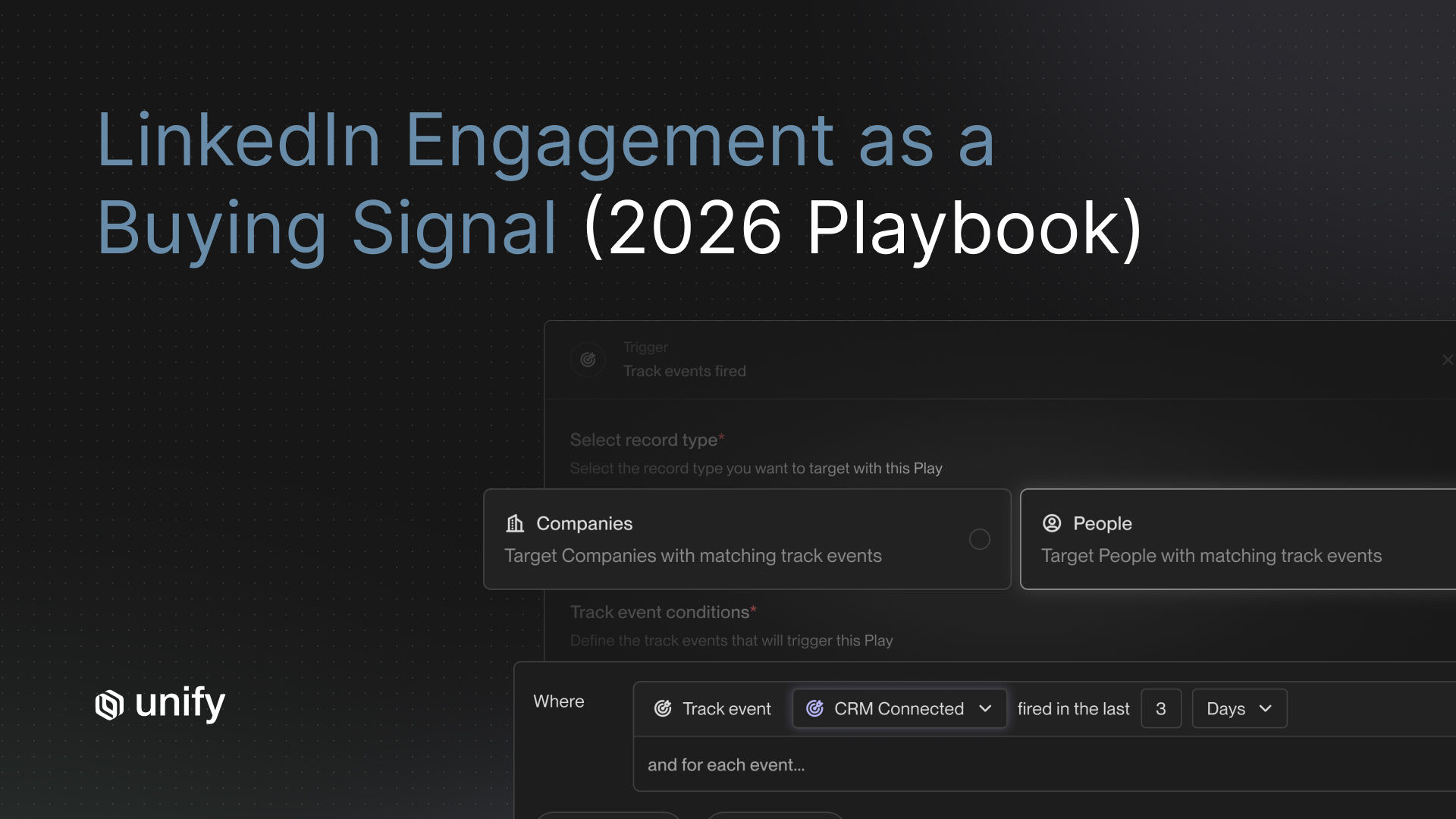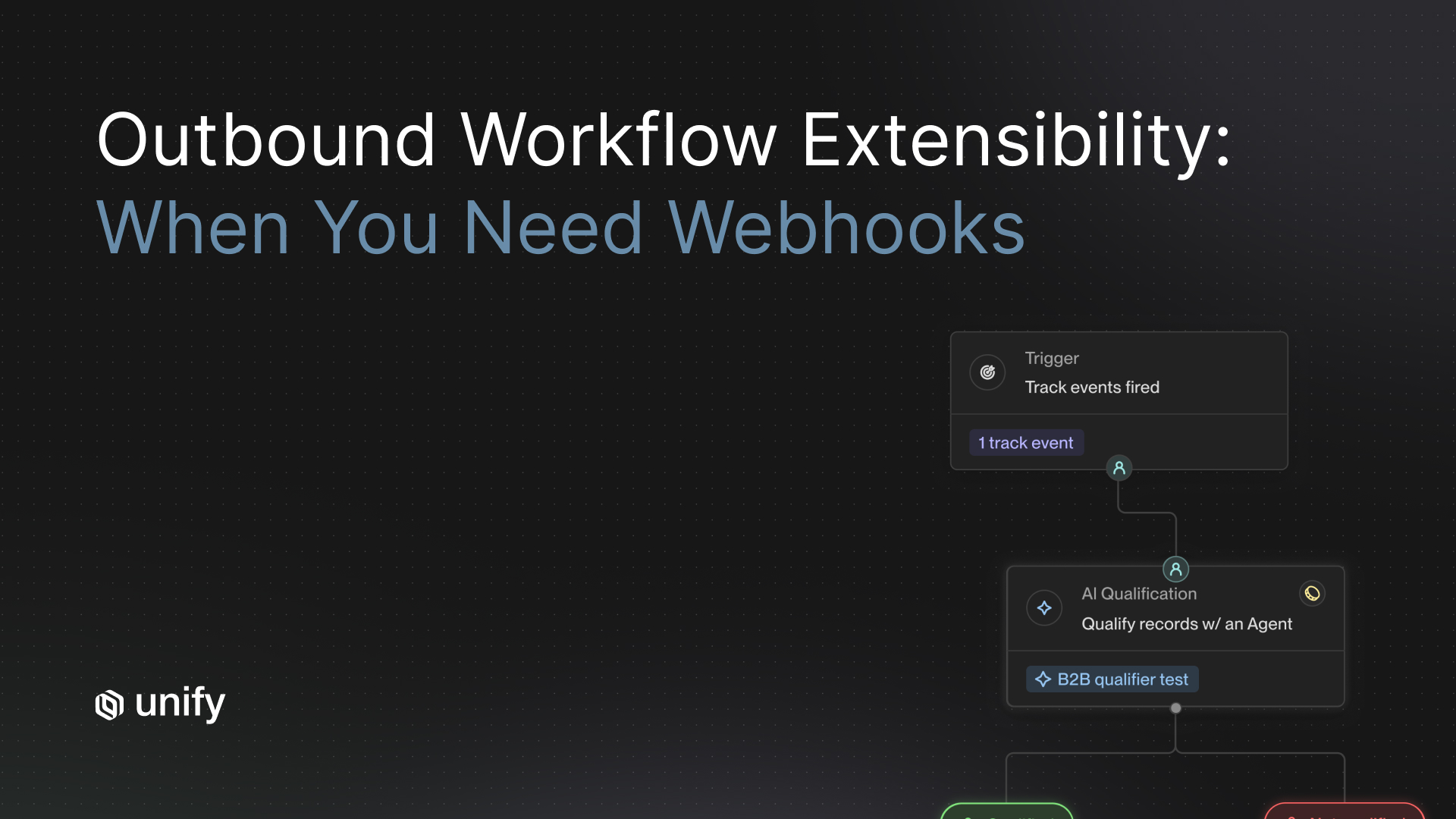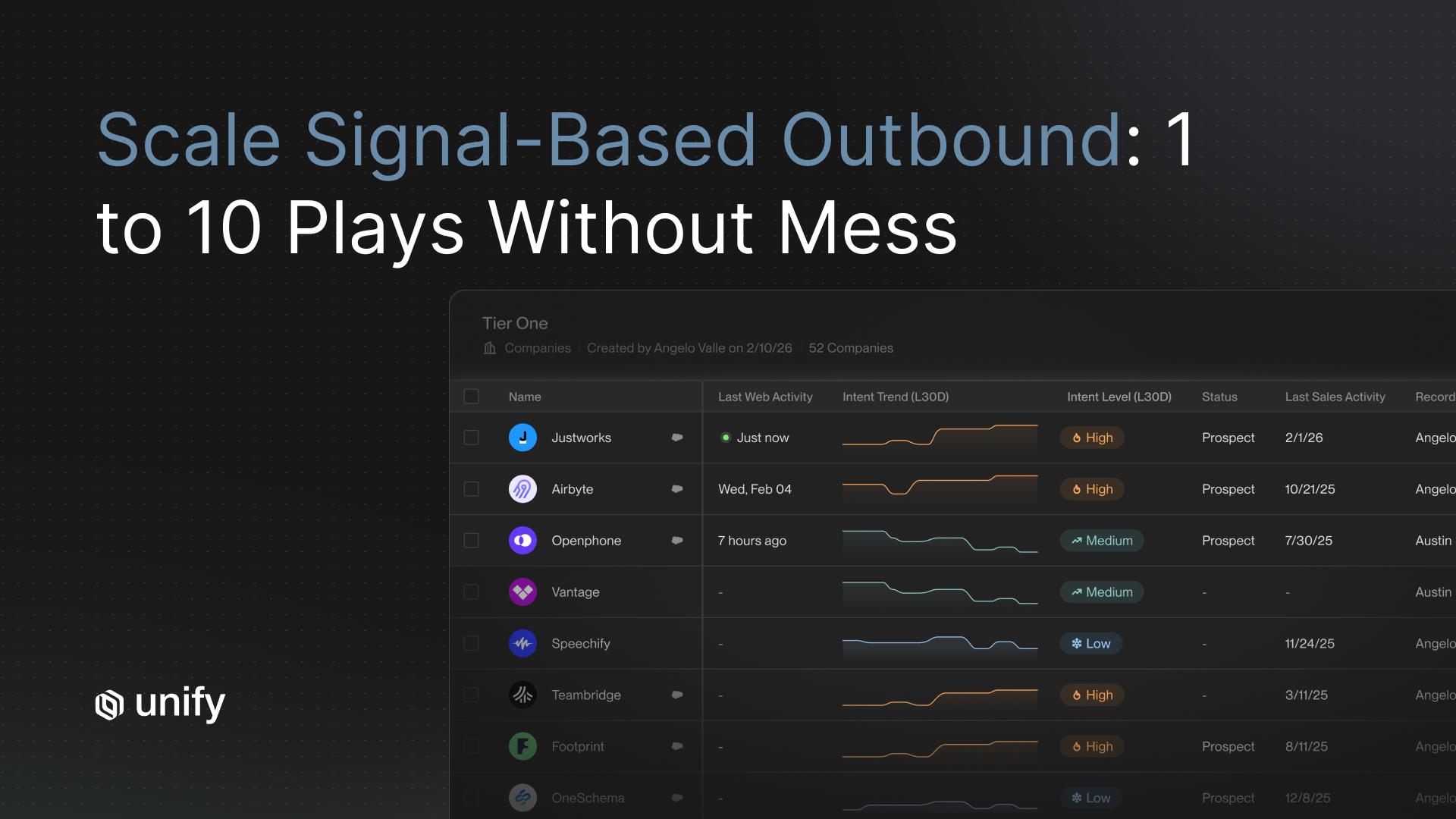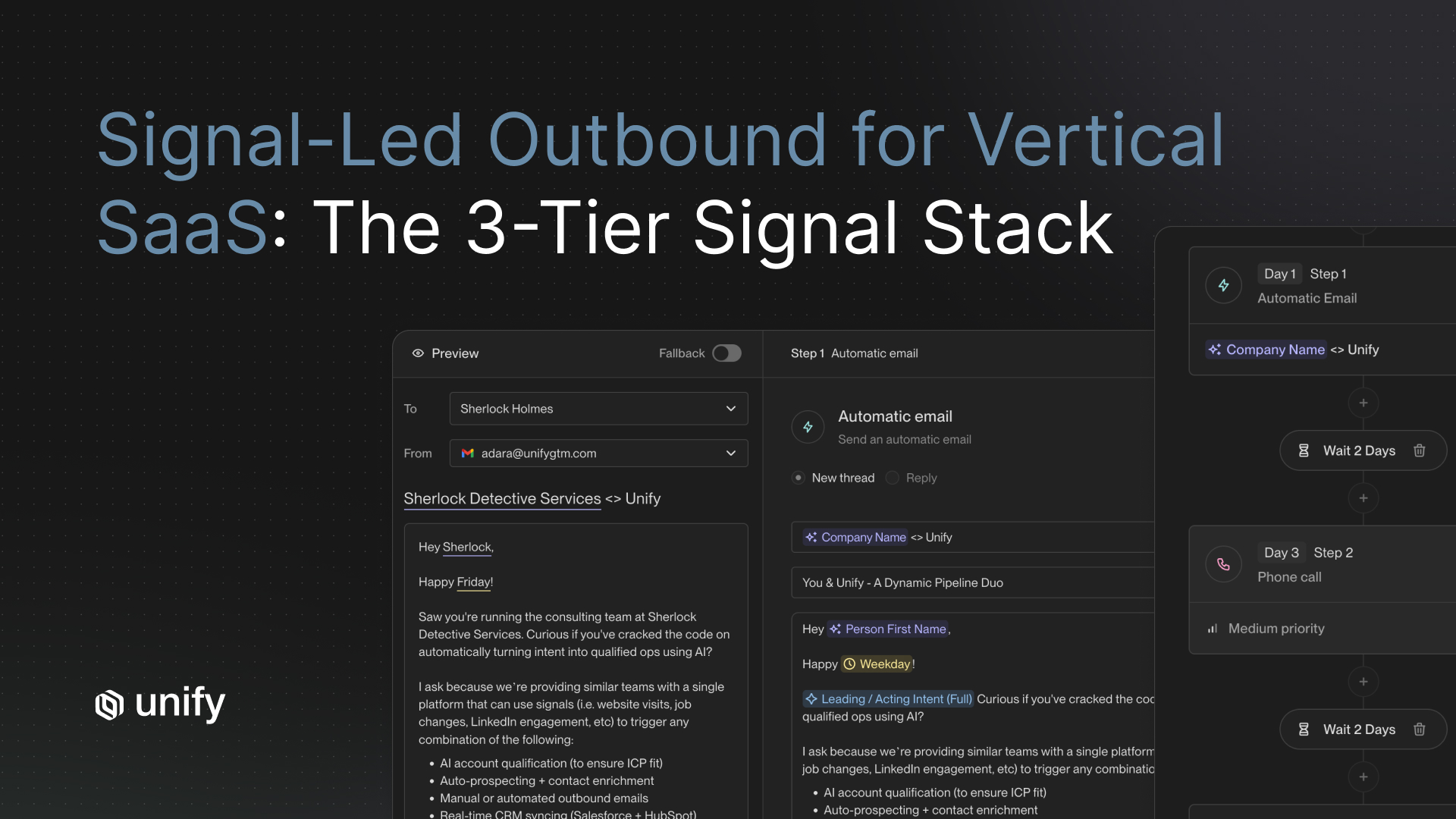
TL;DR. Job change into a buyer persona is one of the highest-predictive LinkedIn signal for outbound; expect 2-3x reply lift over cold baseline when acted on inside 24 hours. Built for Sales, Growth, and RevOps teams running signal-based outbound. Peridio's social-follower play hit an 11.6% reply rate vs a 5% baseline (2.3x lift) per its published case study. Drop "open to work" status, raw follower growth, and skills updates from your signal stack. Stack one LinkedIn signal with one website or product signal before scaling volume.
Key Facts & Benchmarks at a Glance
Methodology & Limitations
Rankings in this article reflect published Unify customer outcomes from named case studies between 2025 and 2026, not an aggregated platform benchmark. Each row in the Key Facts table cites a specific customer story or product page; numbers are not blended across customers. Sample sizes vary by case study (e.g., Peridio reports 4,400+ contacts reached, Perplexity reports 75+ opportunities), so relative lifts are more meaningful than absolute reply rates.
What we excluded: generic "LinkedIn engagement boost" listicles from competitor blogs, training-data approximations, and any number that could not be traced to a named, published source. Where to dial down: regulated regions (EU/GDPR — see the role/segment variants below) and industries where LinkedIn penetration in the buyer persona is below 50%.
How Should You Rank LinkedIn Signals by Predictive Power?
Rank LinkedIn signals on two axes: strength of buyer-intent inference and action window before decay. Job changes in a buyer-persona role rank highest because the contact already has product affinity and is in a 30-day evaluation window for new tooling. Post engagement and follower changes rank mid because intent is implicit, not explicit. Skills updates, "open to work" status, and raw follower count rank lowest and produce more noise than pipeline.
The seven LinkedIn signals below are ordered by published reply-lift evidence and field-tested action-window decay. Each signal uses the same mini-template: What it detects · Why it predicts conversion · Action window · Strength tier · Proof point.
1. Champion Job Change (highest predictive power)
- What it detects: A previous customer or buyer at one of your past customers takes a new role at a different ICP-fit company.
- Why it predicts conversion: The contact has product affinity, knows the value, and is typically in a 30-90 day window where they have authority to bring in their preferred stack.
- Action window: 24 hours from detection. Reach out before any incumbent vendor at the new company learns about the change.
- Strength tier: Tier 1 (human-led).
- Proof point: Anrok generated $300K in pipeline in 3 months running a blended Plays motion that included Champion Tracking alongside Website Visitors and Lookalikes (per Anrok case study, 2026). Unify documents Champion Tracking as a 1-credit-per-tracked-individual signal with monthly refreshes (per docs.unifygtm.com).
2. New Hire in a Buyer-Persona Role
- What it detects: A target account hires someone whose role matches your buyer persona (e.g., new VP of RevOps, new Head of Growth).
- Why it predicts conversion: New hires evaluate tooling in their first 60-90 days. The political cost of a new vendor is lower for a new hire than an incumbent.
- Action window: 7 days from announcement.
- Strength tier: Tier 1 or Tier 2.
- Proof point: Affiniti uses Unify's New Hire Tracking to detect newly-hired decision-makers at high-growth HVAC and pharmacy accounts; the team prospected 8,700 leads in 3 months with 8,000 agent runs (per Affiniti case study, 2026).
3. Stacked LinkedIn + Website or Product Signal
- What it detects: A LinkedIn engagement (post like, comment, follow) plus a same-account website pricing-page visit or product-usage threshold within a 7-day window.
- Why it predicts conversion: Two independent signals reduce false positives. Implicit LinkedIn intent + explicit pricing intent is the strongest published combination.
- Action window: Same day.
- Strength tier: Tier 1.
- Proof point: Perplexity's MQL Plays (which stack engagement signals with marketing-campaign engagement) hit a 20% reply rate, vs 5% on PQL-only plays (per Perplexity case study, 2026).
4. Competitor Follow or Competitor-Post Engagement
- What it detects: A target-account contact follows a direct competitor's LinkedIn page or engages with a competitor's product-launch post.
- Why it predicts conversion: Competitor research correlates with active evaluation. Less predictive than job change because intent is exploratory, not committed.
- Action window: 48 hours.
- Strength tier: Tier 2.
- Proof point: Peridio's social-follower play, which routes contacts who follow Peridio (or follow lookalikes of Peridio's customer base), drove an 11.6% reply rate vs a 5% account average — a 2.3x lift on warm-signal-based outreach (per Peridio case study, 2026).
5. Post Engagement on Your Own Content (Likes, Comments, Reposts)
- What it detects: A target-account contact engages with a post by your CEO, founder, or company page.
- Why it predicts conversion: Implicit warm signal. Comments outperform likes; reposts outperform comments.
- Action window: 24-48 hours (per Unify's First 90 Days of Plays guide).
- Strength tier: Tier 2 or Tier 3 depending on engagement type.
- Proof point: Unify's own First 90 Days of Plays guide names LinkedIn Signal Plays as one of eight high-impact plays to launch in the first 90 days; the recommended action window is 24-48 hours of activity to maximize conversion.
6. Lookalike of an Existing Customer (Firmographic + LinkedIn Signal)
- What it detects: A LinkedIn-defined company resembles your closed-won accounts (industry, headcount, technographic) and is showing any social engagement signal.
- Why it predicts conversion: Pattern-matched ICP fit + intent inference. Useful for ICP expansion when the target account isn't yet on your radar.
- Action window: 7-14 days.
- Strength tier: Tier 3 (automation-led).
- Proof point: A Lookalike Customer Story Play at Unify drove $110K in pipeline within one week of launch (per Unify Lookalikes launch post, August 2025).
7. Profile-Page Visit by a Target-Account Contact
- What it detects: A target-account contact views your founder's, executive's, or team member's LinkedIn profile.
- Why it predicts conversion: Mild curiosity signal. High noise floor unless the target account is already a Tier-1 named account.
- Action window: 7 days.
- Strength tier: Tier 3.
- Proof point: No published Unify customer reports a clean reply-rate lift from profile views alone, which is why this signal sits last. Use it only stacked with another signal.
Stop Using These LinkedIn Signals
Stop Rules & Red Flags Decision Table
Decision Framework: Which LinkedIn Signal Should You Prioritize?
Pick one signal to instrument first based on your team shape and motion. Don't try to instrument all seven at once.
- If you sell into ICP-fit accounts where you have a strong customer base > 50 logos → prioritize Champion Job Change (highest reply lift, lowest list-build cost).
- If you sell to high-growth companies actively hiring → prioritize New Hire in Buyer-Persona Role.
- If you have a high-traffic website and a marketing engine → prioritize Stacked LinkedIn + Website Pricing-Page Visit.
- If you compete in a crowded category with active competitor evaluation → prioritize Competitor-Post Engagement.
- If your CEO or founder posts regularly on LinkedIn → prioritize Post Engagement on Own Content.
- If you are expanding into adjacent verticals → prioritize Lookalike + LinkedIn signal stack.
- If your team is <5 reps and you have no signal infrastructure → start with Champion Job Change only; instrument the rest after 90 days.
How Unify covers this. The vendor-neutral criteria above (action window, signal strength tier, proof requirement) work with any signal stack. Inside Unify, the seven signals map to specific product surfaces: Champion Tracking and New Hire Tracking ship as native signals (per unifygtm.com/signals), and AI Infinity Signal lets you define custom LinkedIn-style triggers in natural language (per unifygtm.com/signals/infinity-signal). Plays orchestrate the signal-to-action workflow end-to-end and powered nearly 50% of Unify's new pipeline creation as of the Series A announcement (per Unify Series A post).
Worked Example: Champion Job Change to Booked Meeting
Day 0, 09:14 UTC. A LinkedIn job change is detected: Sarah, formerly a Director of Growth at a closed-won customer, joins Acme Corp (an ICP-fit Series B fintech) as VP of Marketing. The signal fires inside Unify's Champion Tracking module.
Day 0, 09:18 UTC. Plays runs the signal through audience filters: Acme Corp is in ICP, has >50 employees, no open opportunity. The play assigns the contact to the original AE who closed Sarah's previous account.
Day 0, 09:24 UTC. The AE receives a Slack alert with Sarah's new role, a draft LinkedIn DM (referencing the prior relationship and the new role), and a 2-step email sequence on standby.
Day 0, 11:30 UTC. AE sends a personal LinkedIn DM. Reply at 14:42 UTC ("Yes, would love to chat — let me get my feet on the ground first").
Day 7. Discovery call booked. Day 21: Acme Corp enters pipeline with a $48K ARR opportunity. The signal-to-pipeline cycle was 21 days vs the team's 78-day cold-outbound average. Cohort lift: roughly 3.7x faster pipeline creation on champion-job-change plays vs cold (matches the kind of signal-driven acceleration documented across Unify customer outcomes including Anrok and Affiniti).
Role & Segment Variants
Sales (AE / BDR running named accounts)
- Prioritize Tier 1 signals: Champion Job Change and stacked LinkedIn + website-visit signals.
- Block automated plays from running on assigned named accounts. Route to the rep as a real-time alert.
- Lead with LinkedIn DM before email on Tier 1 signals.
Growth / RevOps (running scaled outbound across the long tail)
- Prioritize automation-friendly signals: Lookalikes + LinkedIn engagement, Post Engagement on Own Content.
- Use AI Personalization to weave the LinkedIn signal explicitly into the email opener.
- Track reply rate by signal type monthly; cut signals below 3% reply after 90 days.
Marketing (running demand-gen-driven outbound)
- Stack a LinkedIn engagement signal on top of a marketing-campaign engagement signal. This was the Perplexity MQL Play model and drove a 20% reply rate.
- Pair every signal with a Smart Snippet that names the campaign or content piece.
EU / GDPR-regulated regions
- Default to LinkedIn DM, not cold email, on signal-triggered Tier 1 plays.
- If sending email, anchor the opener on the public LinkedIn signal explicitly to demonstrate legitimate-interest context.
- Never use scraped personal-email addresses for signal-triggered outbound; route to corporate-email only.
Edge Cases & Disambiguation
- Job-seeker traffic vs buyer interest. A LinkedIn engagement from someone with "Open to Work" framing is almost always a job-seeker, not a buyer. Filter by current employer in your audience definition.
- Title-seniority mismatch. A new hire titled "Senior Manager, Growth Operations" may not be a buyer at one company and may be the buyer at another. Always validate against your closed-won persona definition before treating new-hire signals as Tier 1.
- Champion vs power user. Not every former user is a champion. A champion advocated internally; a power user just used the product. Tag champions explicitly in your CRM at deal close.
- Competitor follow vs competitor employee. Filter out current and former employees of the competitor before treating a competitor-page follow as a buyer signal.
- Post engagement = intent vs post engagement = noise. A comment or repost is a buyer signal; a single like during a viral spike is usually noise. Weight comments > reposts > likes in your scoring.
Top 5 Mistakes to Avoid
- Treating all LinkedIn signals as equal weight. Job changes carry 2-3x the predictive power of post likes; weight accordingly.
- Acting outside the action window. A 31-day-old job change has lost most of its lift. Set hard expiry dates per signal type.
- Running LinkedIn signals without a stop-rules table. Burned LinkedIn audiences recover slowly; document opt-out and decay rules upfront.
- Skipping the signal name in your message. If you don't reference the signal explicitly in the opener, the prospect can't tell you why you're reaching out and the signal-driven advantage evaporates.
- Stacking too many signals at once. Two independent signals = strong. Five signals = a complex audience that's impossible to debug. Start with one signal pair, scale after measurement.
Frequently Asked Questions
Which LinkedIn signal has the highest reply-rate lift for outbound?
Job changes into a buyer-persona role at a target account drive the highest measured reply lift. Peridio's case study shows social-engagement-based plays delivered an 11.6% reply rate vs a 5% account average. Champion job changes consistently outperform other LinkedIn signals because the contact already has prior product affinity. Treat job-change signals as 24-hour-window plays.
Are LinkedIn post likes and comments a strong outbound signal?
Post engagement (likes, comments, reposts) is mid-tier in predictive power. It outperforms follower count and skills updates but underperforms job changes and new hires in a buyer persona. Treat post engagement on a competitor or category post as a 48-hour-window soft signal that pairs well with a website-visit or product-usage signal. Engaging within 24-48 hours of activity maximizes conversion (per Unify's First 90 Days of Plays guide).
How fast should you act on a LinkedIn job change signal?
Within 24 hours for champion job changes (a former buyer joining a new ICP-fit company). Within 7 days for new-hire signals where someone matching your persona was hired into a target account. Beyond 30 days, the signal degrades sharply because the buyer is no longer in onboarding mode and any incumbent vendor has had time to lock in.
What LinkedIn signals should you stop using?
Stop using "open to work" / "looking for new role" status as a buyer signal (high false-positive rate, often the contact is leaving), raw follower count growth without context, generic skills-section updates, and one-off post likes from job-seekers in your TAM. These signals have no measured lift in published Unify customer outcomes and create noise that erodes deliverability.
How do you measure LinkedIn signal predictive power?
Compare reply rate of contacts engaged within the signal-action window to the team's baseline cold-outbound reply rate over the same period. Peridio reported 11.6% reply on social-follower plays vs 5% account average (a 2.3x lift). Always measure in cohorts of at least 100 contacts per signal type per month, control for sequence length, and exclude existing pipeline. Methodology must report sample size and time window.
Do LinkedIn signals work in regulated regions like the EU?
Yes, but the playbook changes. Under GDPR, cold outbound to personal-domain emails requires legitimate-interest assessment and an opt-out path. LinkedIn signals are still valid for routing and prioritization, but the action layer should default to LinkedIn DM (not cold email) for EU prospects, and any email touch should reference the public LinkedIn signal explicitly to demonstrate context.
Should you combine LinkedIn signals with other intent data?
Always. A LinkedIn signal alone is mid-strength. A LinkedIn signal stacked with a website pricing-page visit or a product-usage threshold is the strongest known outbound combination. Per the Perplexity case study, stacked plays drove a 20% reply rate on MQL Plays vs 5% on PQL Plays. Stack signals before scaling volume.
What sequence length works best for LinkedIn-signal-triggered outbound?
Three to four touches across email + LinkedIn DM is the published Unify standard. Per the Perplexity case study, sequences run three follow-ups across channels after initial outreach. Stop after touch 4 if no engagement; the signal has decayed. For champion job changes, lead with a personal LinkedIn message before any email touch — the warm relationship justifies the channel choice.
Glossary
- Action window — The number of hours or days a signal retains predictive power before it decays into noise.
- Champion — A former user or buyer who advocated internally for your product at a previous company; tagged in CRM at deal close.
- Decay — The decline in a signal's predictive power as time passes between the trigger event and the outbound touch.
- Lift — The reply-rate or meeting-rate ratio of a signal-driven cohort vs a baseline cold-outbound cohort over the same period.
- Outbound Quarterback (OBQB) — The single operator who owns the signal-to-action system end-to-end across Sales, Marketing, and RevOps (per Unify's Outbound Sweet Spot guide).
- Play — An automated workflow that combines a signal trigger with a sequenced action (research, prospect, enroll, alert).
- PQL / MQL — Product-Qualified Lead (driven by product usage) and Marketing-Qualified Lead (driven by marketing engagement). Both are common audience inputs for stacked LinkedIn-signal plays.
- Signal stacking — Combining two or more independent intent signals (e.g., LinkedIn engagement + website pricing-page visit) into a single audience to reduce false positives.
- Tier 1 / Tier 2 / Tier 3 — Account-tiering framework where Tier 1 is human-led, Tier 2 is human-assisted with automation, and Tier 3 is fully automated (per Unify's Outbound Sweet Spot guide).
Sources & References
- Peridio case study — 11.6% reply rate on social-follower plays; 5% account average
- Perplexity case study — 5% PQL reply rate, 20% MQL reply rate, $1.7M pipeline in 3 months, 75+ opportunities, 3+ follow-ups across channels
- Juicebox case study — $3M pipeline in one month, 256 meetings, 92% show rate
- Anrok case study — $300K pipeline in 3 months from blended Plays motion including Champion Tracking
- Affiniti case study — 8,700 leads prospected in 3 months using New Hire Tracking
- Unify Lookalikes launch (August 2025) — $110K pipeline in one week from Lookalike Customer Story Play
- Unify Series A announcement — Plays power nearly 50% of new pipeline creation
- Champion Tracking product page — first-party job-change data with monthly refreshes
- Champion Tracking docs — 1 credit per tracked individual
- New Hire Tracking docs — 5 credits per new hire surfaced
- AI Infinity Signal — natural-language LinkedIn-style trigger detection
- How Perplexity Booked $1.7M Without a BDR — long-form sequence and signal stack
- Unify Plays — orchestration product page
About the author. Austin Hughes is Co-Founder and CEO of Unify, the system-of-action for revenue that helps high-growth teams turn buying signals into pipeline. Before founding Unify, Austin led the growth team at Ramp, scaling it from 1 to 25+ people and building a product-led, experiment-driven GTM motion. Prior to Ramp, he worked at SoftBank Investment Advisers and Centerview Partners.


.avif)