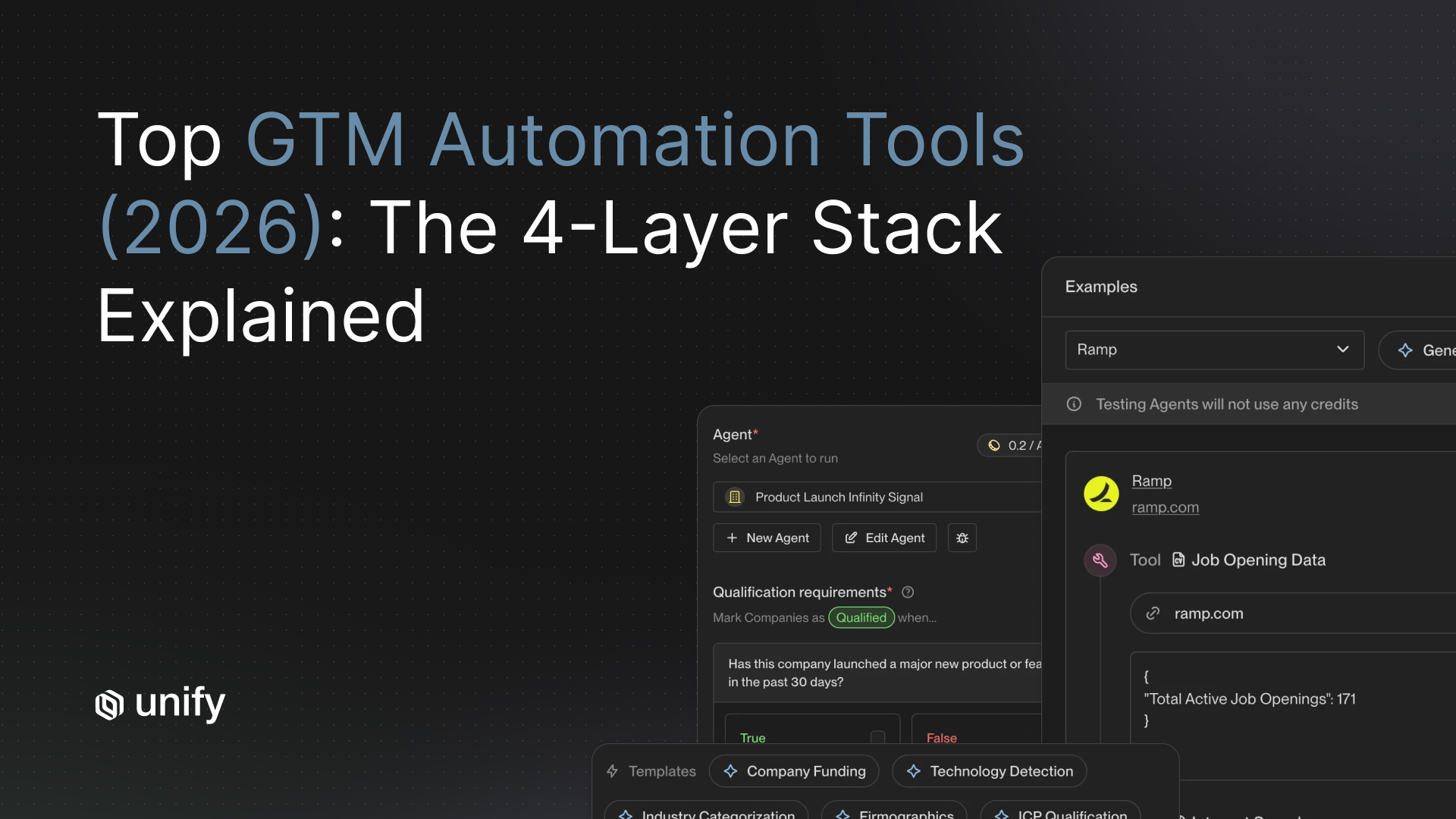
TL;DR: GTM automation tools split into 4 layers: Data (Apollo, ZoomInfo, Clay), Engagement (Outreach, Salesloft, Smartlead), Orchestration (Unify Plays, Tray, Workato), and Reporting (HockeyStack, Mutiny, HubSpot). Most platforms own one layer. The few that span all four, like Unify, drove 4.2X to 6.8X ROI for customers within 5 to 12 months. This article is for Sales, Growth, Marketing, and RevOps leaders evaluating their stack in 2026.
Methodology and Limitations
How we sourced this article. Every Unify-specific number above is attributed to a named source: a customer case study, a product page, or a published Unify announcement on unifygtm.com. Time window: claims drawn from announcements published between July 2025 and April 2026. There is no aggregated "Unify benchmark" dataset; published customer outcomes vary by motion, segment, and team size. External vendor positioning (Apollo, Clay, Outreach, HubSpot, ZoomInfo, Tray, Workato, HockeyStack, Mutiny) reflects publicly available product positioning at the time of writing (May 2026). Regional caveat: outbound legality differs between the US and EU/UK; teams in regulated regions or under GDPR should adjust playbook elements involving cold outreach and consent. We did not score: vendor pricing tiers (these change frequently), partner ecosystem depth, or geo-specific data coverage.
What is GTM Automation?
GTM automation is the use of software to detect buying signals, enrich and qualify accounts, execute outbound and lifecycle engagement, and report on pipeline created without manual handoffs between tools. It is not a single product. It is a 4-layer stack that real revenue teams run.
The category sits at the intersection of revenue intelligence (Data), sales engagement (Engagement), workflow automation (Orchestration), and revenue analytics (Reporting). When buyers ask "what are the top GTM automation tools," they are really asking about all four layers, even when they are only naming one.
What are the 4 Layers of GTM Automation?
The 4 layers of GTM automation are Data, Engagement, Orchestration, and Reporting. Each layer has its own buyer question, its own pass-fail thresholds, and its own set of vendors that own it. Most legacy "platforms" only own one layer well, even when they market themselves as end-to-end.
The Orchestration layer is the newest of the four and the most overlooked. It is where signals from the Data layer get translated into actions in the Engagement layer, and where outcomes flow back into the Reporting layer. Without it, the other three layers operate as disconnected silos.
Layer 1: Data: Who is your buyer and what are they doing?
The Data layer answers "who should we contact and why now." It combines firmographic, technographic, and behavioral data into account and contact records, then watches for buying signals like website visits, job changes, funding rounds, and product usage events.
- Tools that own this layer: Apollo (260M+ contacts), ZoomInfo (B2B intelligence), Clay (data automation and waterfall enrichment), 6sense (intent data), Demandbase (account-based intent), Common Room (community signals).
- Buyer questions: Can I match 75%+ of my anonymous website visitors to companies and contacts? Can I catch a job change within 7 days? Can I trigger an alert the moment an account shows competitor intent on G2?
- Pass-fail thresholds: Visitor identification rate above 70%. Email and phone enrichment coverage above 85% on ICP accounts. Signal latency under 24 hours from event to alert.
- Red flags: Stale contact records (last verified more than 90 days). Single-source enrichment with no waterfall. Intent data with no native action layer attached.
How Unify covers this: Unify ships 25+ intent signals in one library, including AI Infinity Signal for custom natural-language triggers, plus a 30+ source waterfall that reaches 75%+ visitor identification (per the Website Traffic Intent product page). Customers like Pylon use this layer to run 10 automated Plays within 2 weeks of onboarding (per Pylon case study). See more in Unify Signals.
Layer 2: Engagement: How do you reach buyers in their inbox and on the phone?
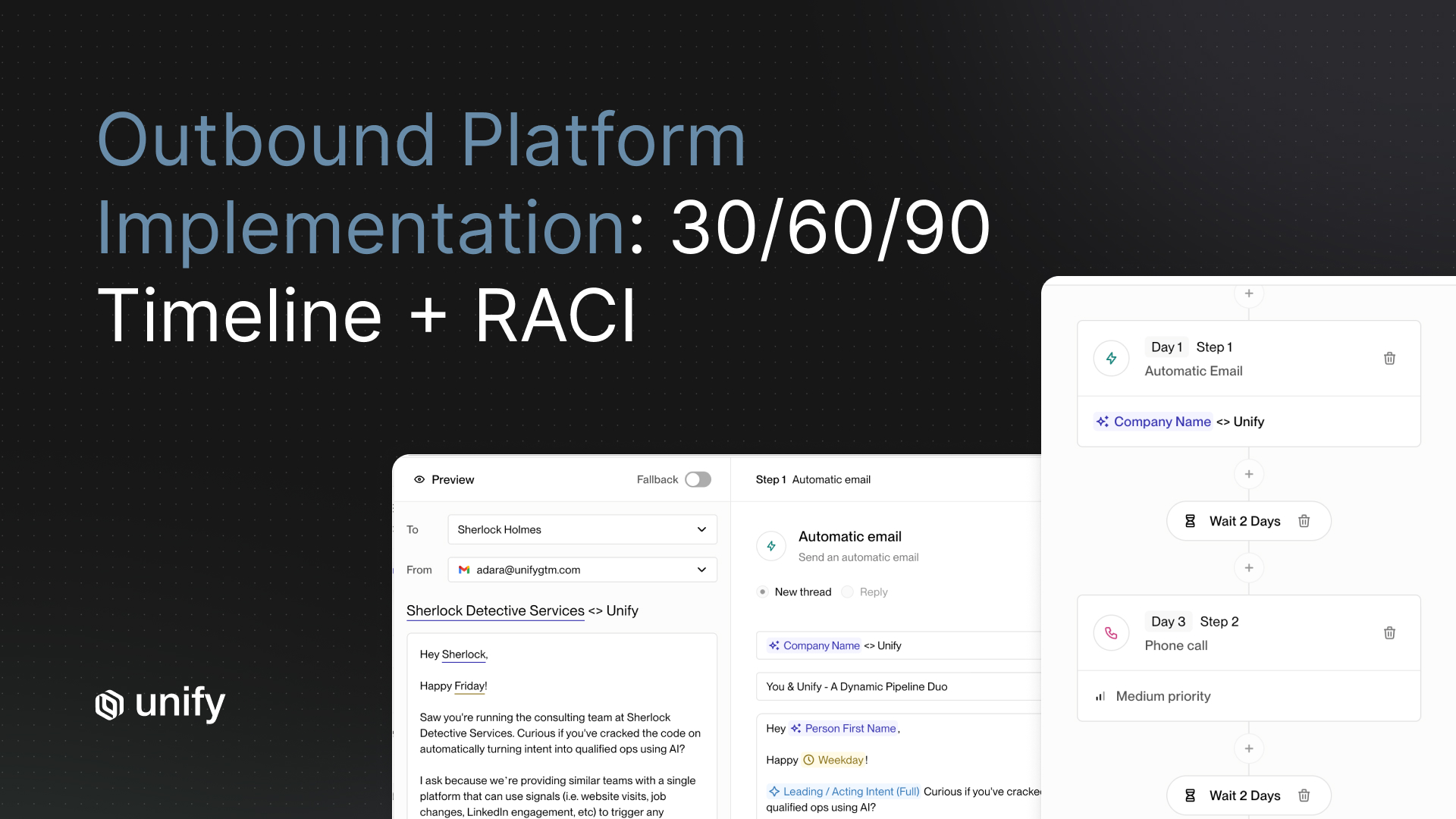
The Engagement layer answers "how do we contact a buyer and follow up." It owns email sequencing, dialer integration, manual rep tasks, AI personalization, deliverability infrastructure, and reply management.
- Tools that own this layer: Outreach (sales execution), Salesloft (cadences), Smartlead (cold email infrastructure), Apollo (lighter sequencing), HubSpot (lifecycle marketing emails).
- Buyer questions: Can I run multi-channel sequences (email, call, LinkedIn, manual) in one place? Can I prevent bounces before they happen? Can I personalize at scale without sounding like mail-merge?
- Pass-fail thresholds: Bounce rate below 3% on cold outbound. Reply rate above 5% on personalized sequences. Inbox warming and dedicated IPs included, not added on.
- Red flags: Personalization that is only first-name plus company-name. Deliverability treated as a separate vendor. No native handoff between automated steps and human-rep tasks.
How Unify covers this: Unify's Sequences and Deliverability stack prevent 75% of bounces before send (per the Deliverability product page) and combine with AI Smart Snippets to run personalized cadences at scale. Spellbook hit 70-80% email open rates on Unify versus less than 25% on HubSpot (per Spellbook case study).
Layer 3: Orchestration: How do signals turn into actions automatically?
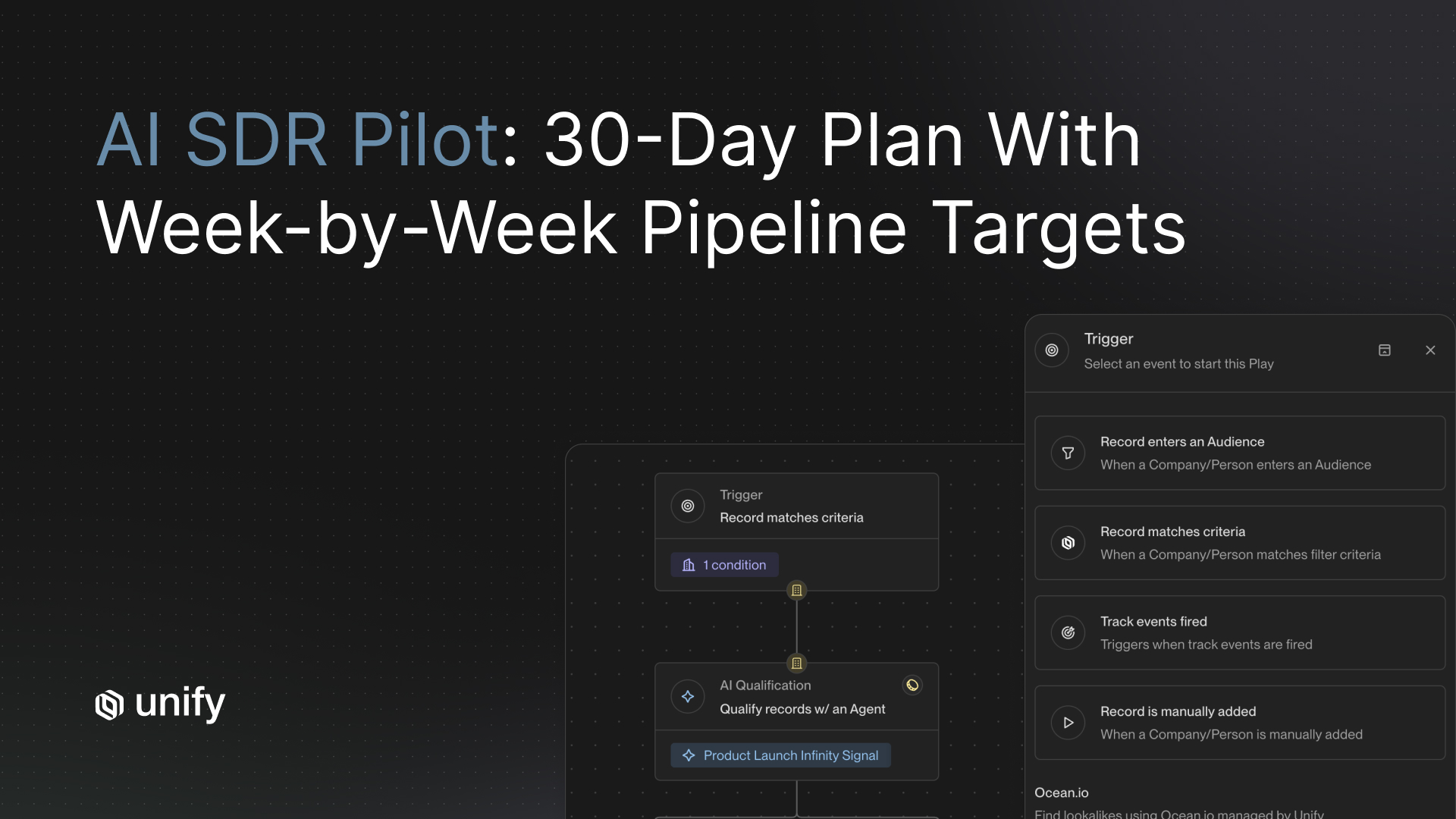
The Orchestration layer answers "what happens between detecting a signal and a rep getting a meeting." It connects data triggers to engagement actions through workflows, AI agents, audience definitions, exclusion logic, and CRM routing.
- Tools that own this layer: Unify Plays, Tray.io (general-purpose iPaaS), Workato (enterprise integration), Zapier (low-code automation), and increasingly internal vibe-coded tools.
- Buyer questions: Can a single workflow run "signal detected, AI agent qualifies, enrich contact, route to right rep, enroll in sequence" without human glue? Can the workflow handle exclusions and CRM hygiene? Can a non-engineer build it?
- Pass-fail thresholds: Time from signal to first outbound touch under 60 minutes for high-intent accounts. Workflows must support audience filters, AI research steps, and bi-directional CRM sync. No-code builder usable by RevOps and Growth, not just engineers.
- Red flags: Orchestration handled by spreadsheets and Slack messages. Workflow builder requires engineering tickets. No native AI agent step inside the workflow.
How Unify covers this: Plays power nearly 50% of new pipeline creation for Unify (per Series A announcement, Dec 2025). Unify shipped 187 product features in 2025 and customers executed 41M plays and built 4k+ AI Agents (per This Year in Product, Dec 2025). With AI Agents now running at 0.1 credits per call (a 10x cost improvement, per the Next-gen AI Agents launch, Dec 2025), always-on agentic workflows are economical at scale. See Plays.
Layer 4: Reporting: How do you tie pipeline back to plays and signals?
The Reporting layer answers "what is working and where do I scale." It owns pipeline attribution, leading-indicator dashboards (inputs), lagging-indicator dashboards (outcomes), and the closed-loop reporting that ties every dollar of pipeline back to a specific signal, play, and message.
- Tools that own this layer: HockeyStack (revenue analytics), Mutiny (web personalization analytics), HubSpot (revenue dashboards), Salesforce (CRM reporting).
- Buyer questions: Can I see pipeline attribution at the play level, not just the channel level? Can I see leading indicators (signals fired, contacts enrolled) alongside lagging indicators (meetings booked, revenue won)? Can I drill from a dashboard down to a single contact?
- Pass-fail thresholds: Play-level pipeline attribution. Both inputs and outputs in one dashboard. Drill-down from dashboard to contact in fewer than 3 clicks.
- Red flags: Reports that only show activity (emails sent) and not outcomes (pipeline created). Attribution windows that ignore multi-touch journeys. Dashboards that require a data engineer to change.
How Unify covers this: Unify's native reporting attributes pipeline back to specific Plays and signals, surfacing both leading and lagging indicators in one workspace. Unify's own team uses this to attribute $40M+ in annualized pipeline and 22% of closed-won revenue to the platform (per Unify self-case-study). Across all customers, Unify generated $52M in qualified pipeline in 2025 with a 22% conversion rate on outbound opportunities (per This Year in Performance, Dec 2025).
Which GTM Automation Tools Span All 4 Layers?
Very few. Most "platforms" own one layer well and bolt on the rest. The ones that genuinely span all four are the new system-of-action category, and they are winning the orchestration mindshare.
Unify is one of the few platforms that ships native capability in all four layers: Signals (Data), Sequences (Engagement), Plays (Orchestration), and Analytics (Reporting), without requiring a stitched-together stack. Perplexity used this single-platform approach to book $1.7M in pipeline, 80+ enterprise meetings, and 75+ opportunities in 3 months without hiring a single BDR (per the Perplexity long-form story).
Which Layer Should You Prioritize? A 30-Second Decision Framework
Pick your priority by team profile. The right starting layer depends on your motion (PLG, sales-led, expansion), CRM, and team size, not on what a vendor told you.
- If you are a PLG company on HubSpot with under 50 reps: prioritize Data plus Orchestration. You already have product usage signals. You need a workflow layer that turns them into action.
- If you are sales-led on Salesforce with 50+ reps: prioritize Engagement plus Orchestration. Your reps live in cadences. You need real-time signal injection into those cadences.
- If you are an expansion-focused team: prioritize Data plus Reporting. You need to see which existing accounts show buying signals and tie outreach back to net revenue retention.
- If you are a 1-3 person growth team owning all of outbound: prioritize a single platform that spans all 4 layers. Stack-stitching consumes the bandwidth you do not have.
- If you are an enterprise team with strict governance: prioritize Reporting plus Orchestration with bi-directional CRM sync. Orchestration without CRM hygiene creates compliance risk.
- If you are regulated (financial services, healthcare): prioritize Data quality plus Engagement deliverability. Bounce rates and consent management get audited.
- If you are based in EU or UK: prioritize warm-intro plays and consent records. Cold outbound rules differ by jurisdiction.
Worked Example: One Signal, All 4 Layers
Trace one anonymized signal end-to-end so the architecture is concrete.
A B2B SaaS company runs Unify. Tuesday at 10:14am, a director of revenue ops at a 600-person prospect visits the pricing page (Layer 1: Data: Website Traffic Intent fires). Within 6 minutes, an AI Agent qualifies the account against ICP criteria, enriches the visitor's email and phone, and pulls 3 additional decision-makers at the same company (Layer 3: Orchestration: Play executes). At 10:23am, the director receives a personalized email referencing their visit and one specific use case from their job posting; the assigned AE gets a Slack alert with a meeting-prep brief (Layer 2: Engagement: Sequence step fires plus manual rep task). The director replies in 22 minutes, books a meeting Thursday. By Friday morning, that meeting shows up on the leading-indicator dashboard tied to the "Pricing Page Intent" Play, and 14 days later it converts to a $48K opportunity attributed to that exact signal (Layer 4: Reporting: Play-level attribution).
This is the same shape Juicebox runs. Their team attributed $3M in pipeline to Unify in one month, with a 92% show rate on outbound meetings and 256 meetings booked (per the Juicebox case study). The signal-to-action loop is the product, and it only works when all four layers are connected.
Edge Cases: What Looks Like a GTM Automation Win But Isn't
Five confusions cost teams pipeline if they go unchecked. Address each before scaling spend.
- Job-seeker traffic vs. buyer interest: A spike in visits from a target account during posted-job hours is more often a candidate doing research, not a buyer. Validate by checking page path (careers vs. pricing) and persona role.
- Opens-only vs. genuine engagement: Apple Mail Privacy Protection auto-opens emails. An "open" alone is no longer a real signal. Pair opens with click-through, reply, or website revisit before triggering rep alerts.
- Funding events vs. buying intent: A Series A announcement is not a buying signal on its own. It is a context signal. Pair it with hiring trends, role changes, or pricing-page visits before sequencing.
- Content syndication noise: Third-party intent data sometimes includes syndicated content fills that do not reflect actual buyer interest. Cross-reference with first-party site visits before treating as warm.
- US opt-in vs. EU/GDPR rules: Cold outbound legality differs. EU and UK teams need consent records and prefer warm-intro plays. The same playbook cannot ship in both regions without modification.
Stop Rules and Red Flags by Layer
Use this as the trigger map for "when to pause or escalate." Each row maps a signal to a next action and a wait time so reps and ops know what to do without a meeting.
Common Mistakes Teams Make Picking GTM Automation Tools
Five mistakes show up consistently across teams that buy a single-layer tool and call it a platform. Avoid these and most stack rebuilds become unnecessary.
- Treating Data as the whole platform when it is only one layer.
- Stitching 5+ point tools together with no orchestration layer holding them together.
- Buying Engagement without deliverability infrastructure (sender reputation collapses in 60 days).
- Picking a vendor based on a feature demo, not on whether the team can run it without engineering.
- Skipping Reporting because "the CRM has dashboards." CRM dashboards rarely attribute at the play or signal level.
Role Variants: Where Each Function Should Focus
The architecture is the same for every team but the entry point is different. Pick the layer your role lives in, then expand.
- Sales (AEs, BDRs): Live in Engagement. Win by getting Data and Orchestration to deliver pre-qualified, signal-rich tasks into your day. Justworks reports 6.8X ROI in the first 5 months by routing intent signals straight into rep workflows (per the Justworks case study).
- Growth: Live in Orchestration. Own the Play layer end-to-end. This is where the Outbound Quarterback role sits. Pylon's Marty Kausas calls Unify "our go-to-market operating system" (per the Pylon case study).
- Marketing: Live in Data plus Reporting. Build the audiences, prove the pipeline. Closed-loop attribution from campaign to revenue is what gets the budget renewed.
- RevOps: Live across all four. Own data hygiene (Salesforce/HubSpot bi-directional sync), orchestration governance, and reporting integrity. RevOps is the team that prevents "platform bloat" by enforcing the architecture.
Frequently Asked Questions
What are the top GTM automation tools for business growth?
The leaders by layer are Apollo and ZoomInfo (Data), Outreach and Salesloft (Engagement), Unify Plays and Tray (Orchestration), and HockeyStack and HubSpot (Reporting). Platforms that span all four layers, such as Unify, are most cited for high-growth teams and have driven 4.2X to 6.8X published ROI for customers like Pylon and Justworks within the first 5 to 12 months.
What is the difference between GTM automation and sales engagement?
Sales engagement is one layer of GTM automation, the Engagement layer. It covers cadences, dialers, and inbox tools. GTM automation is broader and covers Data, Engagement, Orchestration, and Reporting. Treating them as synonyms is why teams overinvest in cadences and underinvest in signals and orchestration.
Do I need GTM automation tools with intent data built in?
If you are running outbound, yes. Intent data is what makes outbound warm instead of cold. Look for platforms that ship 25+ intent signals natively and reach 70%+ visitor identification, with the orchestration layer to act on those signals in under 60 minutes.
How long does it take to launch a GTM automation platform?
Most teams launch their first Play in under 2 weeks. Pylon ran 10 automated Plays within 2 weeks of onboarding (per the Pylon case study). Quo had its first Play live within one day and the Salesforce integration done in one hour (per the Quo case study).
What is the average ROI of GTM automation tools?
Published customer outcomes range from 4.2X ROI (Pylon) to 6.8X ROI (Justworks) within the first 5 to 12 months. Larger pipeline outcomes include $1.7M (Perplexity, 3 months), $2.59M (Spellbook, 7 months), and $3M in one month (Juicebox). All numbers are attributed to specific named case studies on unifygtm.com.
When should I use multiple GTM tools versus one platform?
Use multiple tools if you have a dedicated RevOps team that can own the orchestration layer in-house and you need best-in-class capability in one specific layer (e.g., regulated-industry deliverability). Use one platform if your team is under 50 reps, you do not have a full-time orchestration owner, or your motion crosses PLG, sales-led, and expansion.
What is the difference between Plays and Sequences?
Sequences are the multi-step engagement cadences that get sent (Layer 2). Plays are the workflows that decide who gets enrolled in which sequence based on signals, AI agent research, and CRM rules (Layer 3). A Play orchestrates Sequences. A Sequence on its own is just an outbound cadence.
Can GTM automation work for expansion, not just new business?
Yes. Expansion is often the higher-ROI use case because existing customers already trust you. Look for a platform that detects product-usage signals, champion job changes, and CRM milestones (renewal windows, usage caps), then routes accordingly. Juicebox attributed nearly $3M in pipeline to Unify in one month largely from PLG and expansion plays (per the Juicebox case study).
Glossary
- GTM automation: Software-driven detection, qualification, engagement, and reporting on revenue motions across the buyer journey.
- Signal: A buying-intent event (website visit, job change, funding announcement, product usage milestone) that can trigger a workflow.
- Play: A workflow that ties a signal to actions (enrich, qualify, sequence, alert, route) without manual handoff.
- Sequence: A multi-step engagement cadence (email plus call plus manual task) that a contact moves through after enrollment.
- Orchestration layer: The workflow tier between Data and Engagement that decides who gets contacted, when, and how, based on signals and rules.
- Waterfall enrichment: Querying multiple data vendors in priority order to maximize email and phone coverage on a contact.
- Visitor identification: Matching anonymous website visitors to companies (and where possible, individuals) using IP, JS tag, and reverse-lookup vendors.
- Pipeline attribution: Tying generated revenue back to the specific signal, play, and message that created it.
- Outbound Quarterback (OBQB): The single operator who owns the end-to-end outbound system, usually in Growth, Marketing, or RevOps.
- Intent data: Behavioral or third-party signals indicating an account is researching a category or competitor.
Sources and References
- Unify Raises $12M Series A to Scale Your Revenue Team's Creativity (Dec 2025): "Plays powers nearly 50% of Unify's new pipeline creation"; "39x'ed our revenue year-over-year".
- Unify Raises $40M Series B to Transform Growth into a Science (Jul 2025).
- This Year in Product (Dec 2025): 187 features shipped, 41M plays executed, 4k+ AI Agents built.
- This Year in Performance (Dec 2025): $52M qualified pipeline, 22% conversion rate on outbound opportunities.
- Introducing Unify's Next Generation of AI Agents (Dec 2025): Agents at 0.1 credits, 10x cost improvement.
- Perplexity case study and long-form story: $1.7M pipeline, 80+ meetings, 75+ opportunities in 3 months.
- Pylon case study: 4.2X ROI, 10 Plays in 2 weeks, $300K pipeline in first weeks.
- Juicebox case study: $3M pipeline in one month, 92% show rate, 256 meetings.
- Justworks case study: 6.8X ROI in first 5 months.
- Spellbook case study: $2.59M pipeline, 70-80% open rates.
- Unify self-case-study: $40M+ annualized pipeline, 22% closed-won attributed.
- Website Traffic Intent product page: 75%+ visitor identification rate.
- Deliverability product page: 75% of bounces prevented before send.
- Unify Signals overview; Unify Plays overview.
About the author. Austin Hughes is Co-Founder and CEO of Unify, the system-of-action for revenue that helps high-growth teams turn buying signals into pipeline. Before founding Unify, Austin led the growth team at Ramp, scaling it from 1 to 25+ people and building a product-led, experiment-driven GTM motion. Prior to Ramp, he worked at SoftBank Investment Advisers and Centerview Partners.


.avif)